
Introduction
Why One‑Time Winners Stall After the First Order
A hard‑converting SKU can still be a bad business. Internal operational data across North American and European DTC brands shows repeat buyers contribute roughly 40% of revenue in mature stores—yet fewer than 18% of one‑time‑purchase SKUs generate a second order within 90 days. The pattern intensifies after Q4: holiday gift buyers acquired in December vanish in January, leaving stores with record revenue and an empty February pipeline.
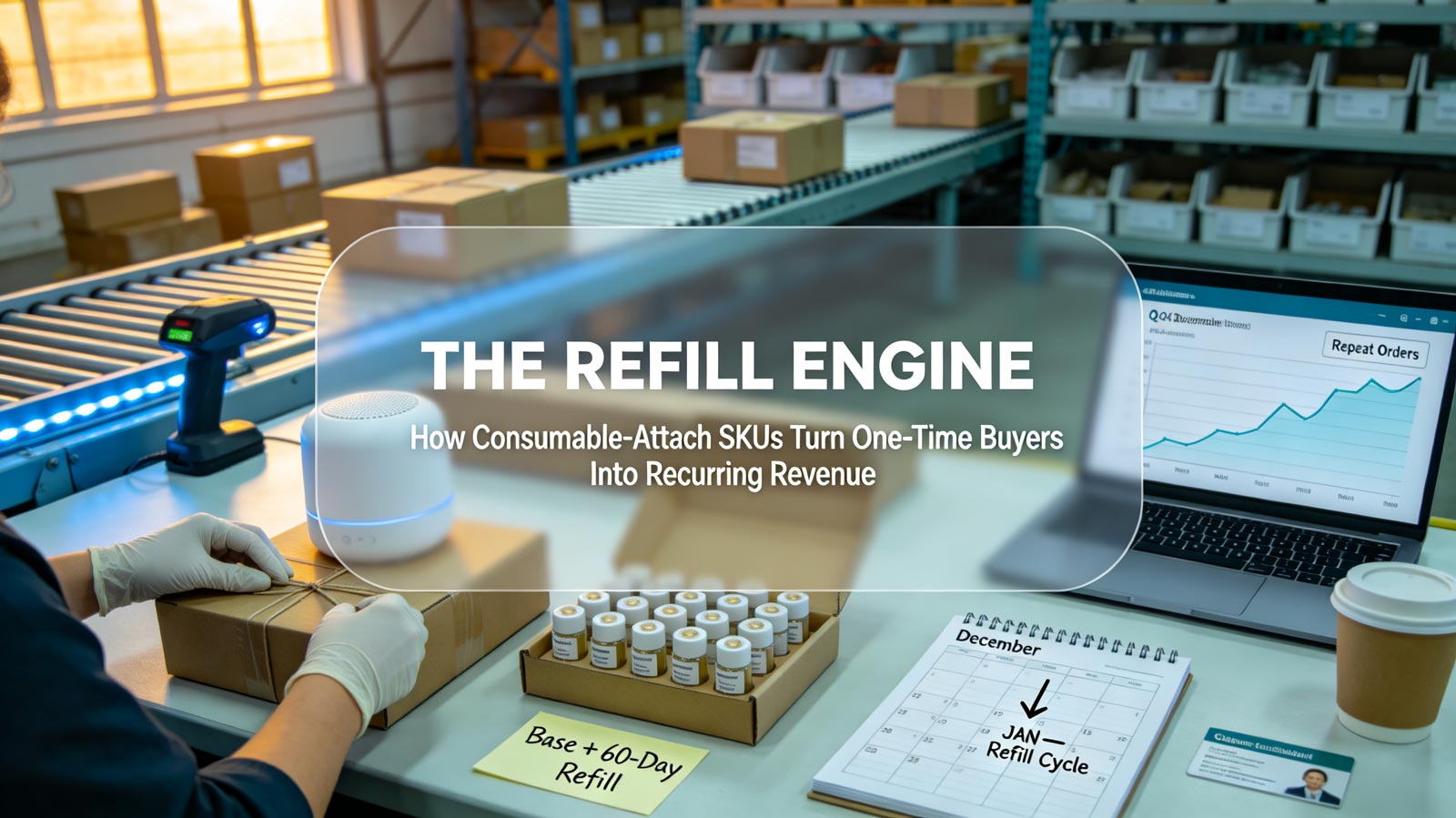
The root cause sits upstream, in product selection. Products without a built‑in next‑purchase trigger depend entirely on paid re‑acquisition. Products with a built‑in replenishment cycle convert acquisition spend into annuity‑style revenue. For Q4 planning, this distinction matters twice: once for December conversion, and once for the Q5 window that follows.
The Four Refill‑Attach Screening Criteria
Measurable consumption cycle:Refill demand must be predictable. Buyers should finish the consumable on a roughly fixed cycle—30, 45, or 60 days—so replenishment emails, subscriptions, and inventory forecasts can be scheduled with confidence. Products consumed at irregular rates (think multi‑year durables with occasional refills) fail this filter.
Base‑to‑refill attachment strength: The base product must lock buyers into your refills. This works when refills are proprietary‑fit (device‑specific cartridges) or when your refill holds a verified quality edge over generic substitutes. Weak attachment means the base becomes a one‑time sale and generics capture every refill.
Margin split health: A common structure: the base product sells near break‑even as the acquisition hook, while refills carry 55%+ gross margin. The blended margin across base plus twelve months of refills should stay above 35%—otherwise the economics are no better than a one‑time winner.
Shelf‑stable fulfillment profile: Refills must survive 30+ day sea freight, warehouse dwell time, and domestic last‑mile delivery without degrading. Screen out anything leak‑prone, temperature‑sensitive, or fragile at refill‑unit size. Low‑AOV replenishment orders leave no room for damage losses or reshipments.
Refill‑Ready Categories for the Q4→Q5 Window
- Home fragrance systems — diffuser base plus refill pods. December gifting demand converts naturally into January pod replenishment, with festive gift bundles lifting AOV upfront.
- Pet care consumables — waste bags, litter, dental sticks. Consumption cycles are fixed by pet size, churn is low, and subscription attach rates run well above store averages.
- Cleaning concentrate systems — reusable bottle plus concentrate tablets. Eco positioning supports premium refill pricing, and tablet form keeps shipping weight near zero.
- Personal care device refills — brush heads, serum cartridges, filter replacements. The device anchors the relationship; the refill carries the margin. Verify regional compliance documentation for any skin‑contact consumable before bulk sourcing.
The Q4‑to‑Q5 Execution Playbook
- ecember: Structure gift bundles as base plus a two‑month refill pack. Every gift buyer becomes a timed January refill prospect—pair this with the cohort metrics framework in our Store Analysis column to track gift‑buyer quality.
- January: Trigger win‑back flows at 80–90% of the consumption cycle, not on a generic schedule. A 45‑day refill should receive its first replenishment prompt around day 38.
- Inventory: Forecast January refill demand at 60–70% of Q4 base‑unit volume, and keep refills stocked in local fulfillment centers—low‑AOV orders cannot absorb cross‑border shipping costs.
- Fulfillment: Pre‑kit December gift bundles in the warehouse to cut pick‑and‑pack time during peak, and use AI demand forecasting to align refill replenishment with actual sell‑through rather than static templates.
Core Takeaways
- Repeat‑purchase economics are decided at product selection, not by post‑purchase marketing—screen for refill‑attach structure before committing inventory budget.
- Run every candidate through four filters: measurable consumption cycle, base‑to‑refill attachment strength, healthy margin split, and shelf‑stable logistics.
- Time the cycle around the calendar: Q4 gift bundles plus January replenishment flows convert one‑time holiday buyers into Q5 recurring revenue.
- Protect refill margins operationally with pre‑kitted bundles, local warehouse stocking, and demand‑forecast‑driven replenishment.