
Introduction
Why Demo‑Ability Now Decides Product Discovery
Feed algorithms distribute content based on watch time and replay rate, not ad budgets. A SKU whose value is visible in the first three seconds of a clip earns free impressions every time a user scrolls past; a SKU that requires explanation pays for every single view.
Internal platform data from Q2–Q3 2026 shows that listings led by self‑demonstrating product clips reached a 2.3× higher organic traffic share than listings relying on static images and copy‑led creatives, with comparable pricing and review counts. For cross‑border merchants facing rising paid‑traffic costs, demo‑ability has shifted from a marketing preference to a selection‑stage economic filter.
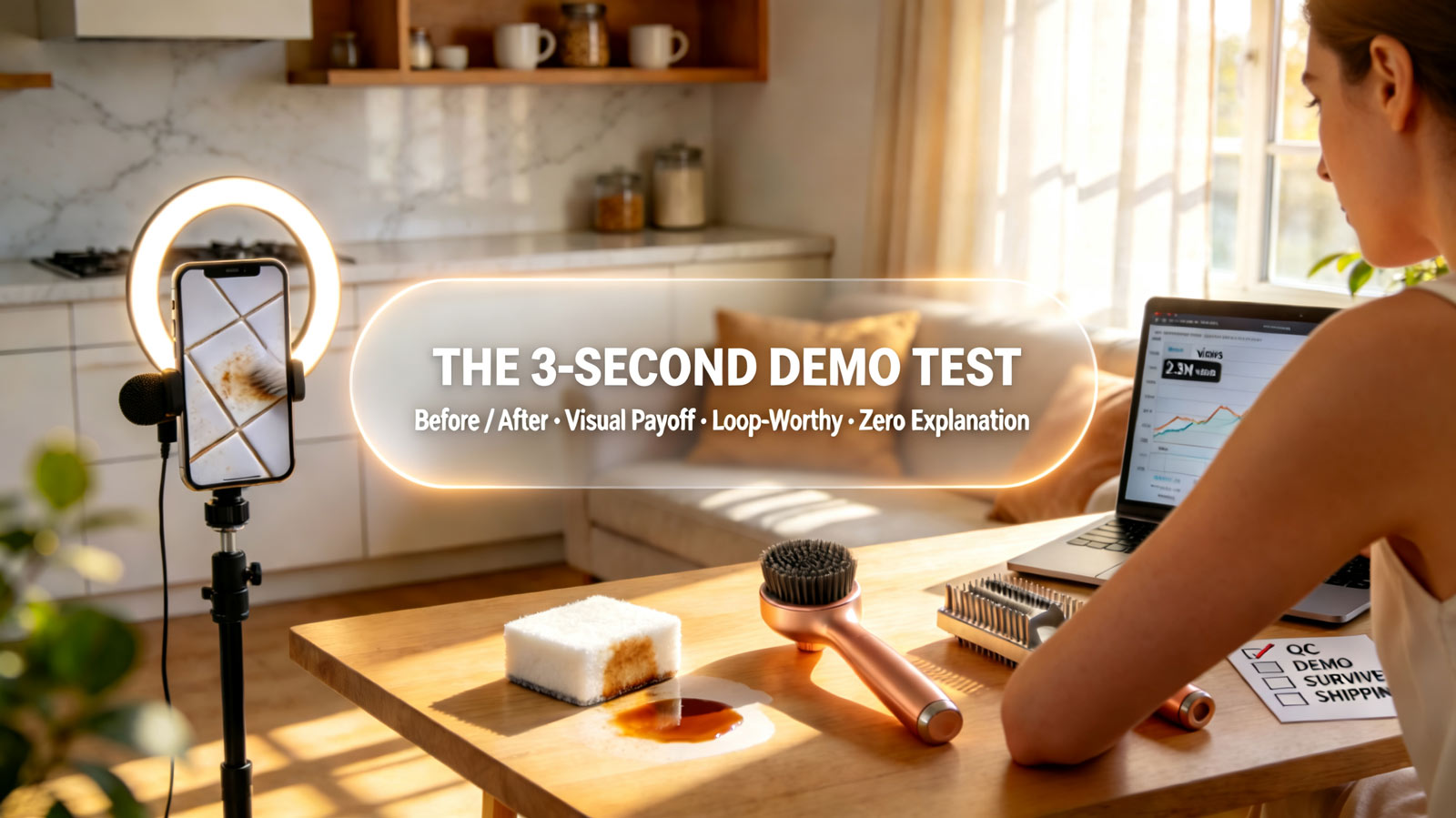
The Four‑Criteria 3‑Second Demo Framework
Apply all four criteria during sourcing. SKUs failing two or more should be treated as paid‑traffic‑dependent, with unit economics calculated accordingly.
- Criterion 1: Instant Before/After Contrast —The product produces a visible transformation within one shot — a stained surface wiped clean, frizzy hair smoothed, a cluttered drawer organized. If the payoff requires a time‑lapse, multiple scenes or a split‑screen comparison, it fails the 3‑second window.
- Criterion 2: Zero‑Explanation Function —A silent viewer with the sound off must understand what the product does and why it matters. Demo‑dependent products — items whose mechanism needs a voiceover, text overlay or tutorial — force merchants to buy attention instead of earning it.
- Criterion 3: Loop‑Worthy Payoff —The demo triggers replay behavior: satisfying textures, precise fits, crisp mechanical actions. Replay rate is the strongest free‑distribution signal in current feed algorithms, and loop‑worthy SKUs keep generating impressions long after posting.
- Criterion 4: Demo Survives Shipping—The "hero feature" shown in the clip must perform identically when the customer opens the box. Products whose demo relies on ideal conditions — pre‑warmed materials, professional staging, accessories not included in the base SKU — convert views into returns and one‑star ratings.
Demo‑Ready SKU Examples for H2 2026
Precision Stain‑Removal & Surface Cleaning Tools Fiber‑based cleaning blocks, targeted stain pens and scrub systems with visible one‑wipe contrast.
- Winning advantages: extreme before/after contrast; silent‑viewer clarity; low unit price with impulse‑friendly conversion
- Merchant tip: Film demos under ordinary household lighting with no edits — overproduced clips raise expectation mismatch and return rates
- Fulfillment note: Rigid applicator heads deform easily in transit; standardized reinforced packaging protects the exact feature your ad promises
One‑Step Hair Styling & Grooming Tools
Heat‑free curling systems, straightening brushes and beard shaping tools with immediate visible results on camera.
- Winning advantages: personal‑relevance targeting drives high save/share rates; demo works across all major short‑form platforms
- Merchant tip: Use real hair textures across multiple demo clips to broaden audience identification and avoid niche‑limited creative fatigue
- Fulfillment note: Heat elements require pre‑shipment functional QC; verify each unit powers on correctly so the first use matches the demo
Mechanical Kitchen Prep Gadgets
Mistake 1: Confusing demo editing with product payoff —A heavily edited clip can manufacture contrast the physical product cannot deliver. Always screen candidates with a raw single‑take demo before sourcing.
Mistake 2: Ignoring the out‑of‑box gap —Products needing assembly, charging or pairing before the first payoff moment fail Criterion 4. The customer's first three seconds with the real product matter as much as the viewer's first three seconds with the clip.
Mistake 3: Selecting demo‑only SKUs with weak underlying demand—A spectacular clip attached to a product nobody needs weekly still fails the long‑cycle stability standards in our Store Analysis column. Demo‑ability amplifies demand; it does not create it.
Mistake 4: Shipping demo‑critical units without protective standards —Cracked demo surfaces, bent applicator heads or dead batteries destroy the exact feature your creative promised. Align packaging specs with the hero feature before scaling ad spend.
Core Takeaways
- Demo‑ability is now an economic filter, not a marketing style — SKUs that demonstrate themselves in 3 silent seconds earn free distribution that paid traffic cannot replicate.
- Screen every candidate against four criteria: instant before/after contrast, zero‑explanation function, loop‑worthy payoff, and a demo that survives shipping intact.
- The out‑of‑box experience must match the ad's promise — protect the hero feature in packaging and enforce pre‑shipment QC, or demo‑driven conversions convert into returns.
- Demo‑ability amplifies real demand but never replaces it; pair visually‑driven picks with the long‑cycle stability metrics in our Store Analysis column before committing bulk inventory.