
Introduction
The Urgency Economy: Why Problem‑Intensity Beats Trend Velocity
Trend‑driven selection optimizes for curiosity, and curiosity is price‑sensitive. A buyer who clicks a viral gadget can wait, compare, and abandon the cart. A buyer with an active problem — poor sleep last night, a stiff neck this morning, an anxious dog every thunderstorm — is not shopping; they are procuring relief. Three structural advantages make urgency‑driven SKUs the quiet compounding winners of a catalog:
- Full‑price tolerance under pressure. Urgent buyers treat price as a secondary variable behind "does this work, and how fast." A $42 solution to a problem happening now routinely outsells a $19 product that merely entertains.
- Cold‑traffic conversion. Products solving felt problems do not need brand trust or retargeting to convert. The buyer arrives pre‑sold by their own discomfort, which collapses customer acquisition cost to its floor.
- Review velocity with substance. Relief products generate specific, credible reviews ("worked the first night") that compound faster than novelty reviews ("cute"). Review quality directly lifts conversion and suppresses return rates.
The catch: urgent demand punishes operational failure twice as hard. When a customer buys relief, a slow or damaged delivery is not a delay — it is a lost night, a lost week, a one‑star review written at peak frustration.
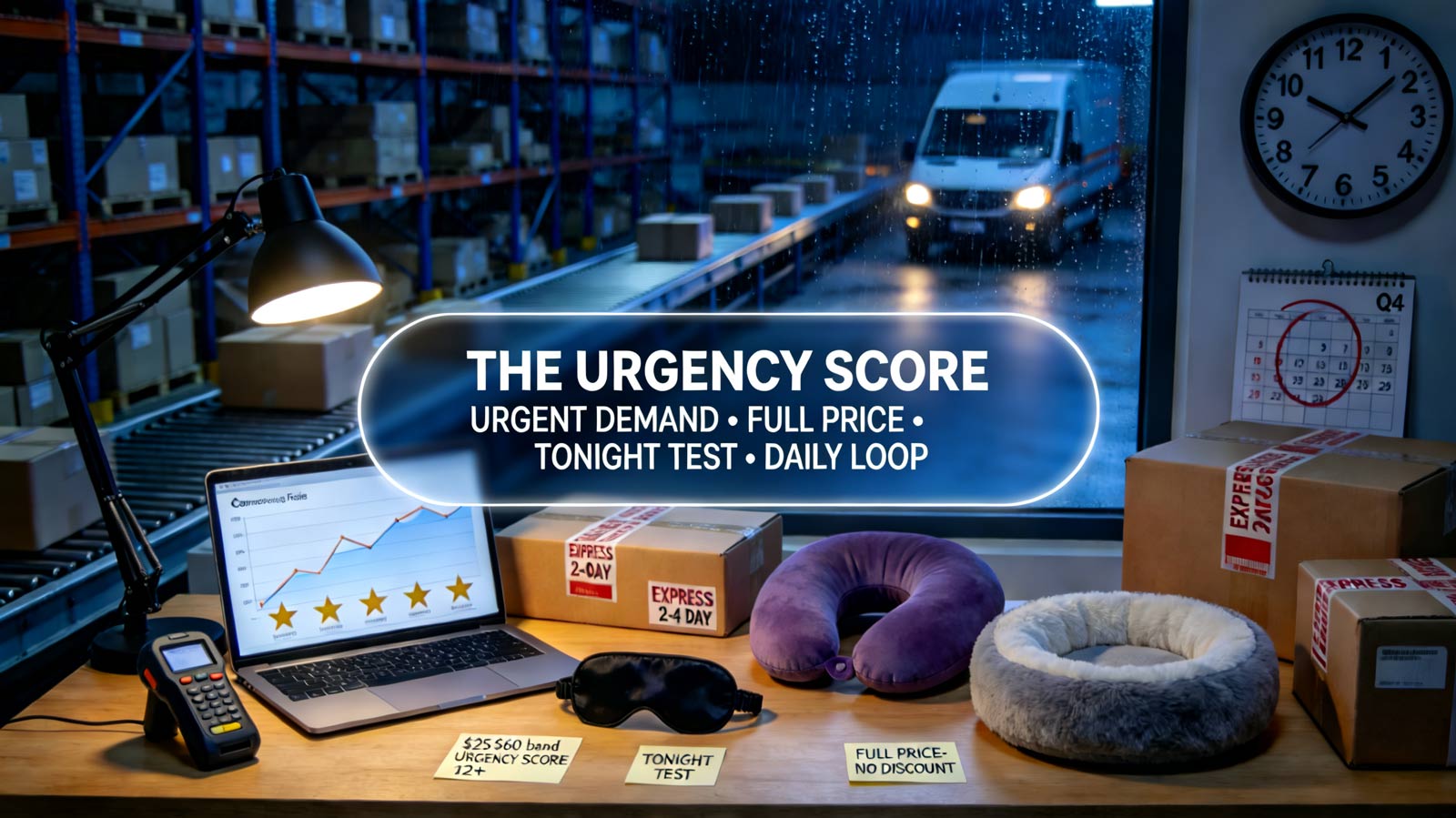
The Three‑Criteria Urgency Score
Apply these three criteria to any candidate SKU before committing inventory budget. Score each from 1–5; products totaling 12 or above earn priority allocation.
Immediacy — the "tonight" test
Ask whether the buyer needs the problem solved now, not eventually. Sleep, pain, and anxiety products pass because the discomfort is active at the moment of purchase; long‑horizon wellness and novelty items fail because the buyer can defer indefinitely. Deferrable demand decays in the cart. Urgent demand closes in one session.
Frequency — the daily‑loop test
Does the problem recur daily or weekly? Recurring discomfort sustains usage, and usage sustains reviews, referrals, and repeat adjacency purchases. One‑time problems (a wedding, a move) create spikes without compounding; daily problems create a durable demand floor that survives seasonality and algorithm changes.
Felt difference — the relief‑signal test
Can the buyer perceive improvement quickly and clearly? Products with a fast, perceptible feedback loop generate confident reviews and low return rates; slow‑or‑uncertain outcomes generate doubt, disputes, and "didn't work" returns. If the relief cannot be felt within the first one or two uses, the product fails this criterion regardless of how real its benefits are.
Fulfillment Is Half the Product: Urgent‑Demand Order Standards
Urgent demand treats delivery time as part of the product itself, which changes the operational calculus of every winning SKU.
- Speed is a conversion feature, not a perk. For relief products, every additional transit day erodes the product's core value. Position urgency‑scored SKUs in overseas warehouses with demonstrated 2–4 day delivery to your core markets, and advertise that speed — it justifies the premium price band.
- Stockout cost is permanent, not delayed. A trend buyer waits for a restock; an urgent buyer buys the alternative tonight and rarely returns. Keep safety stock depth on urgency SKUs 20–30% above trend SKUs of equal velocity, and treat stockouts as lost customers, not deferred revenue.
- Instruction clarity is a return‑rate lever. Relief products fail in the customer's hands when directions are ambiguous. Invest in clear setup or usage inserts before scaling spend — the leading driver of "didn't work" returns is incorrect use, not product defect.
- January demand does not collapse. Unlike gift SKUs, urgency SKUs carry straight through Q4 into January with minimal decay — the problem does not take a holiday. Plan replenishment for the post‑holiday window rather than liquidating in December.
What Passes the Score: Three Urgency‑Backed Directions for Q4 2026
Running candidate categories through the Urgency Score, three structures consistently surface for the 2026 window and beyond:
- Sleep and recovery aids — sleep masks, jaw‑relaxation tools, and weighted‑adjacent comfort items. They pass the "tonight" test decisively, sit in the $25–$60 impulse‑relief band, and generate some of the highest‑velocity credible reviews in home categories.
- Posture and daily‑pain relief — neck stretchers, lumbar supports, and desk‑ergonomics correctors. Daily recurrence plus felt difference within the first week produces strong organic review compounding and low exchange volume, with broad demographic reach.
- Pet anxiety and calming products — calming beds, anxiety wraps, and noise‑soothing accessories. The problem recurs with every storm, fireworks night, and separation, the buyer is emotionally motivated to pay full price fast, and the category tolerates standard parcel handling without damage surprises.
Core Takeaways
- Urgent buyers pay full price, convert cold, and review honestly — rank candidate products by problem intensity instead of chasing trend velocity and rented demand.
- Three criteria identify urgency winners: the "tonight" test of immediacy, the daily‑loop test of frequency, and the relief‑signal test of felt difference; a combined score of 12+ earns inventory priority.
- A slow or damaged delivery destroys the product's core promise: position urgency SKUs in overseas warehouses, hold deeper safety stock, and treat every stockout as a permanently lost customer.
- Urgency SKUs do not decay after the holidays — plan replenishment through January, because the problem, unlike the trend, does not take a season off.