
Introduction
The One-Time Trap: What Trend-Driven Selection Actually Costs
Most operators judge a candidate SKU by first-sale margin and search volume. Both metrics surge during a trend window, creating an illusion of a winning product — while the store quietly locks itself into an acquisition treadmill. The misreading comes from three structural blind spots.
Acquisition costs are visible, repeat revenue is not. A viral gadget shows instant GMV, while the cost of re-purchasing that customer through ads accumulates silently in backend campaigns.
Trend buyers behave differently. Trend-acquired customers rarely return without a discount, and their repeat rate collapses once the trend cools — leaving inventory stranded at overseas warehouses.
One-time SKUs are rarely chosen by lifetime economics. Sellers source whatever is spiking, not what can anchor a recurring refill cycle. Without a replenishment filter, the store rebuilds its customer base from zero every quarter.
The Four Filters of Refill-Driven Selection
Apply these four filters to any candidate SKU before committing inventory budget. Each filter maps to a signal you can verify with a small test batch or your 3PL before the first purchase order.
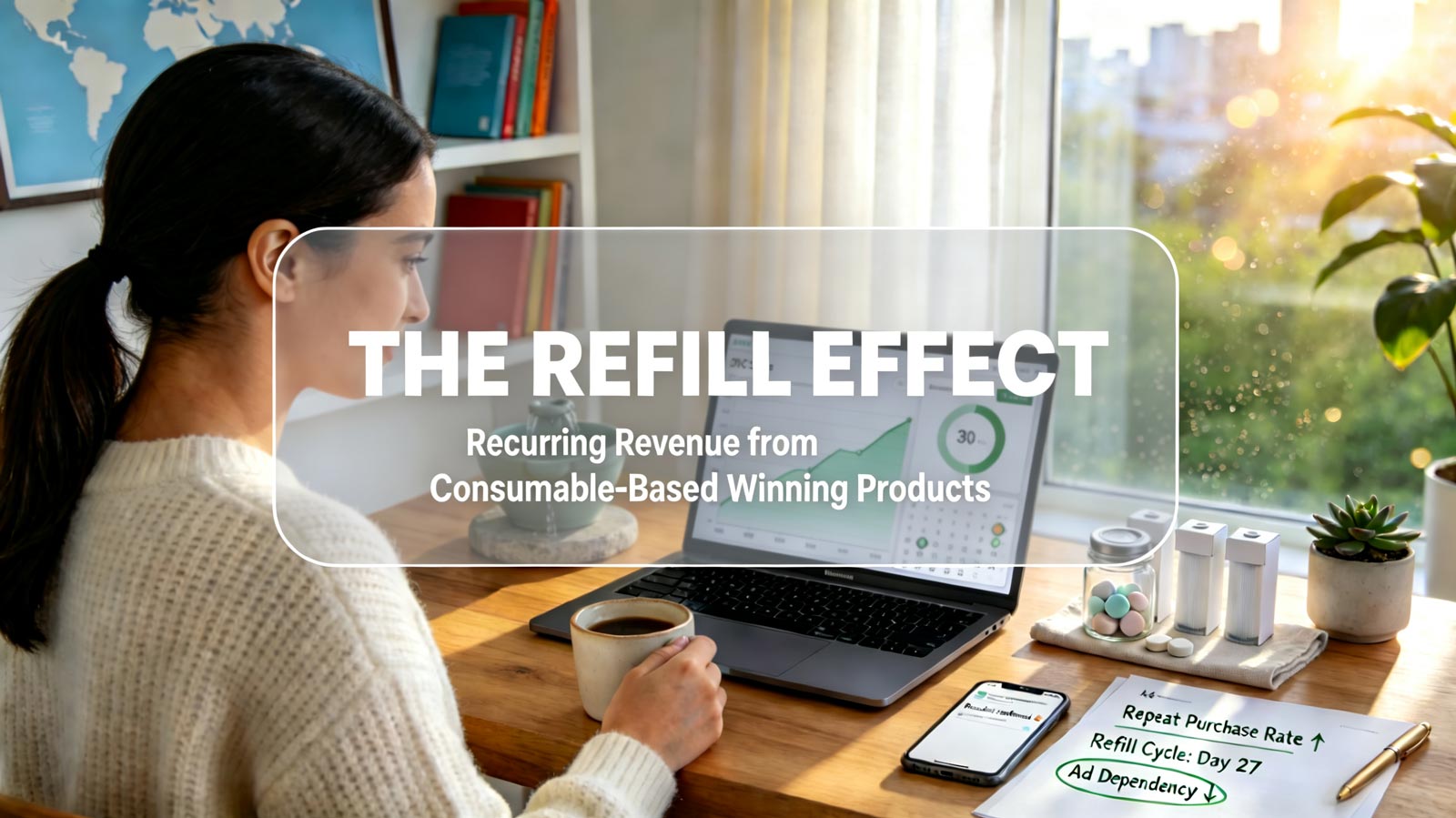
Calendar depletion. True refill SKUs pass the calendar test: the customer runs out on a predictable monthly or quarterly cycle. Merchants with healthy refill economics see a steady share of first-time buyers return within the depletion window; products with vague, preference-based refills rarely generate second orders at all and behave like ordinary one-time goods.
Refill lock-in strength. Refill economics only survive when refills are proprietary or spec-matched to the anchor device. Generic-compatible consumables invite third-party price competition the moment the anchor gains traction — filter out any SKU where the refill interface is an open standard.
Fulfillment economics per refill unit. Evaluate volumetric weight, damage tolerance and bundle-ability. Fast-turning refills justify dedicated overseas stock, and multi-pack refill bundles reliably lift average order value without extra acquisition cost.
Second-order window validation. Before scaling inventory, run a small test batch and measure the refill reorder rate over a full depletion cycle. If too few first buyers come back within the window, the SKU fails the framework regardless of trend data.
Industry Observation: The Refill Revenue Playbook
Refill-disciplined stores treat catalog design as a retention economics project, not a sourcing exercise. Three moves separate them from the pack:
- Price the anchor for conversion, protect the refill margin. Anchor units may run thin; the compounding profit lives in replenishment.
- Build the replenishment trigger. Post-purchase email/SMS flows timed to the depletion cycle convert repeat orders without discounts.
- Stock refills by cycle velocity, not anchor sales. Overseas warehouses buffer refill demand separately so a promo spike never breaks the reorder chain.
The payoff shows up in cohort behavior: replenishment revenue in refill-anchored stores typically overtakes anchor revenue within months of launch, and ad dependency falls as repeat orders compound.
What Passes the Filter: Three Refill-Ready Winning Categories for Late 2026
Apply the four filters and late-2026 candidates cluster into three proven refill structures:
- Pet hydration anchors with filter cartridges. Fountain units convert as health purchases for owners, while roughly monthly filter replacement cycles turn first-time buyers into recurring customers at notably high rates.
- Reusable cleaning systems with dissolvable tablets. Refills ship at a small fraction of bottled-liquid weight, cutting per-reorder logistics cost dramatically and supporting eco-positioning that resonates strongly in EU markets.
- Garment-care anchors with blade and roller refills. Wear-based and usage-based replacement rhythms overlap, creating two natural replenishment streams per customer.
Core Takeaways
- Judge winning products by lifetime revenue, not first-sale margin: refill-anchored SKUs consistently deliver higher customer lifetime value than one-time trend goods.
- Four filters identify refill-driven winners — calendar depletion, refill lock-in, fulfillment economics and second-order validation — all testable with a small batch before bulk commitment.
- Anchor units may convert thin; the refill margin is where recurring revenue compounds, so protect it from generic competition by design.
- Treat refills like inventory with a rhythm: cycle-timed triggers, cycle-velocity stock buffers and fulfillment-friendly packaging. That is the operational standard for Q4 2026.