
Introduction
Why Compliance Became the First Gate in 2026
Three regulatory waves have permanently raised the entry barrier for cross-border SKUs:
- EU enforcement expansion: The EU's General Product Safety Regulation, fully applicable since December 2024, requires a responsible person established in Europe for most consumer goods—and marketplaces are held jointly accountable when non-compliant listings slip through.
- US safety scrutiny: The Consumer Product Safety Commission has expanded oversight of imported consumer products, and categories like children's goods legally require certificates backed by third-party lab testing.
- Logistics-side screening: Air-freight rules require documented UN 38.3 lithium battery test reports and safety data sheets before carriers accept goods—uncertified batteries or liquids simply don't board planes.
The commercial consequence: a SKU with viral demand but incomplete certification is a liability, not an asset. Winning product selection now starts with a question most sellers skip—"can this product legally and physically reach the customer?"
Gate One: Map Certifications Before You Shortlist
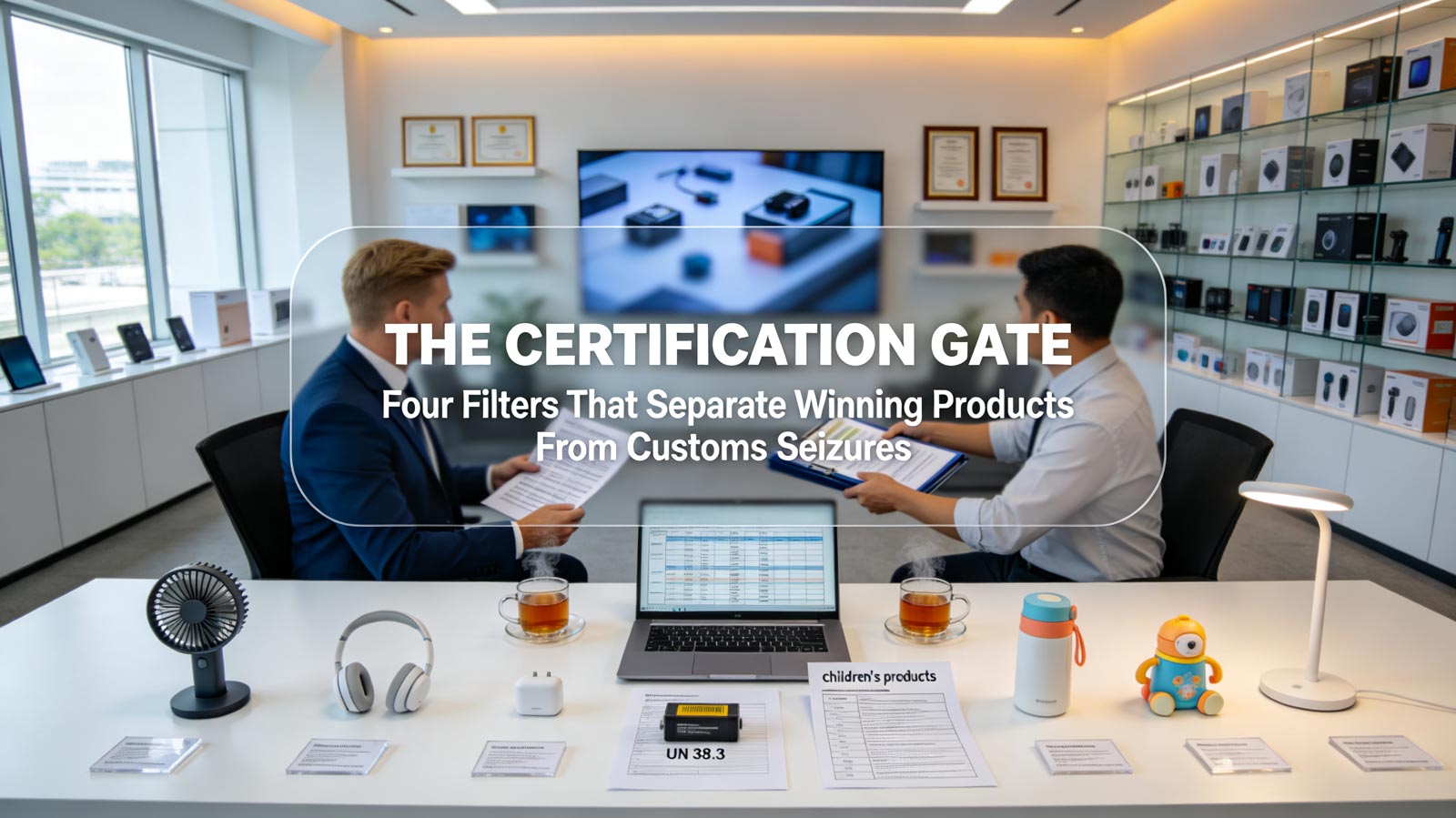
Before shortlisting any product, map its mandatory certifications for every target market. Each category carries its own requirements:
- Electronics need safety testing and FCC radio-frequency approval before selling into the US, plus CE conformity marking for Europe.
- Children's products face the strictest bar—US law requires Children's Product Certificates backed by independent lab testing.
- Anything touching food, skin, or cosmetics requires FDA-adjacent registration and ingredient review in the destination country.
- Textiles need accurate fiber content labeling in the US and chemical safety compliance in the EU.
Diagnostic signal: If the supplier cannot produce test reports within 48 hours, the product is not ready to source—regardless of margin.
Merchant tip: Build a certification checklist per target market and require suppliers to complete it before price negotiation. Suppliers with real export experience will already hold the documents; those who hesitate are telling you something.
Gate Two: Screen Materials at the Freight Level
The second gate filters products at the material level:
- Batteries: Lithium cells need UN 38.3 test reports and safety data sheets for air freight; many carriers cap how much can ship per parcel.
- Liquids & aerosols: Classified as dangerous goods; many fulfillment centers refuse them entirely.
- Strong magnets: Trigger air-transport screening and shipping surcharges.
- Fragrances & chemicals: Perfume-adjacent and chemical products face ingredient restrictions and California's Proposition 65 warning requirements.
Diagnostic signal: Products combining a battery, a liquid, and a motor (massage guns, humidifiers, kitchen gadgets) fail this gate disproportionately often—not because they're bad products, but because shipping them cross-border requires special freight channels that erase margins.
Merchant tip: Ask suppliers directly: "How does this ship—standard freight or dangerous goods—and what documentation do you provide?" Experienced suppliers answer instantly; hesitant ones have never shipped it properly.
Gate Three: Lock Labeling and Packaging Early
A product can be fully certified yet still non-compliant on shelf:
- EU recycling rules: Sellers shipping into Germany and France must register with national packaging recycling systems—Germany's LUCID registry, for example, and missing registration numbers now block marketplace listings outright.
- EU product labeling: Goods need traceability details, manufacturer information, and safety warnings in the destination country's language.
- US labeling: Fiber content, country of origin, and state-specific chemical warnings all apply depending on category.
Diagnostic signal: If your packaging artwork lacks space for required markings, redesign before ordering inventory—repackaging seized goods is far more expensive than fixing labels upfront.
Merchant tip: Right-size packaging at this stage. Compliance labeling adds real estate requirements; combined with properly sized packaging (which also cuts dimensional weight), this gate actually improves unit economics rather than just adding cost.
Gate Four: Verify Tariffs Before the Purchase Order
The final gate is customs-side:
- Accurate product classification: Misclassified customs codes are the leading trigger of border delays and penalty assessments.
- Tariff exposure check: Verify current duty rates and any trade-remedy measures—some categories, from solar components to steel furniture, carry punitive anti-dumping duties that erase nominal margins.
- Documentation package: Accurate commercial invoices, certificates of origin where trade agreements apply, and clarity on who acts as importer of record.
Diagnostic signal: If the supplier quotes a "delivered duty paid" price but cannot explain how they classify the product for customs, your shipment carries undisclosed classification risk.
Merchant tip: Run every candidate SKU through a landed-cost calculator including duties before any sourcing decision. Tariff shocks have converted nominally high-margin products into loss-makers faster than any ad cost increase.
Practical Case: A Gadget Store's Compliance-First Turnaround
Consider a typical scenario: a US-focused gadget store built its catalog around impulse-buy electronics—LED strips, mini fans, phone accessories. Strong conversion, but 17% of shipments faced customs holds in one quarter, and two SKUs were permanently delisted for missing safety documentation. Revenue looked fine; cash flow was trapped in seized inventory.
The store rebuilt its workflow with the four gates as mandatory checkpoints: certification checklists before price negotiation, freight screening at shortlisting, recycling registration before European listings, and customs-code verification before purchase orders. The next quarter, customs holds dropped under 3%, delistings went to zero, and supplier negotiations improved—compliance-ready suppliers proved more professional overall. Catalog size shrank 22%; net margin rose 9 points.
Core Takeaways
- Compliance is a selection filter, not a post-sourcing fix—the cheapest customs problem is the one filtered out before the purchase order, so gate SKUs before price negotiation begins.
- Demand three things before any purchase order: destination-market test reports, freight classification documentation where applicable, and a declared customs code—the supplier's response speed predicts shipping reality.
- Recycling registration, safety labeling, and right-sized packaging are joint decisions—handled together at Gate Three, they cut dimensional weight instead of adding cost.
- Tariff and duty verification belongs in the selection stage; landed cost including duties determines the winner, not supplier price.