
Introduction
The Non-Linear Math Behind Discount Depth
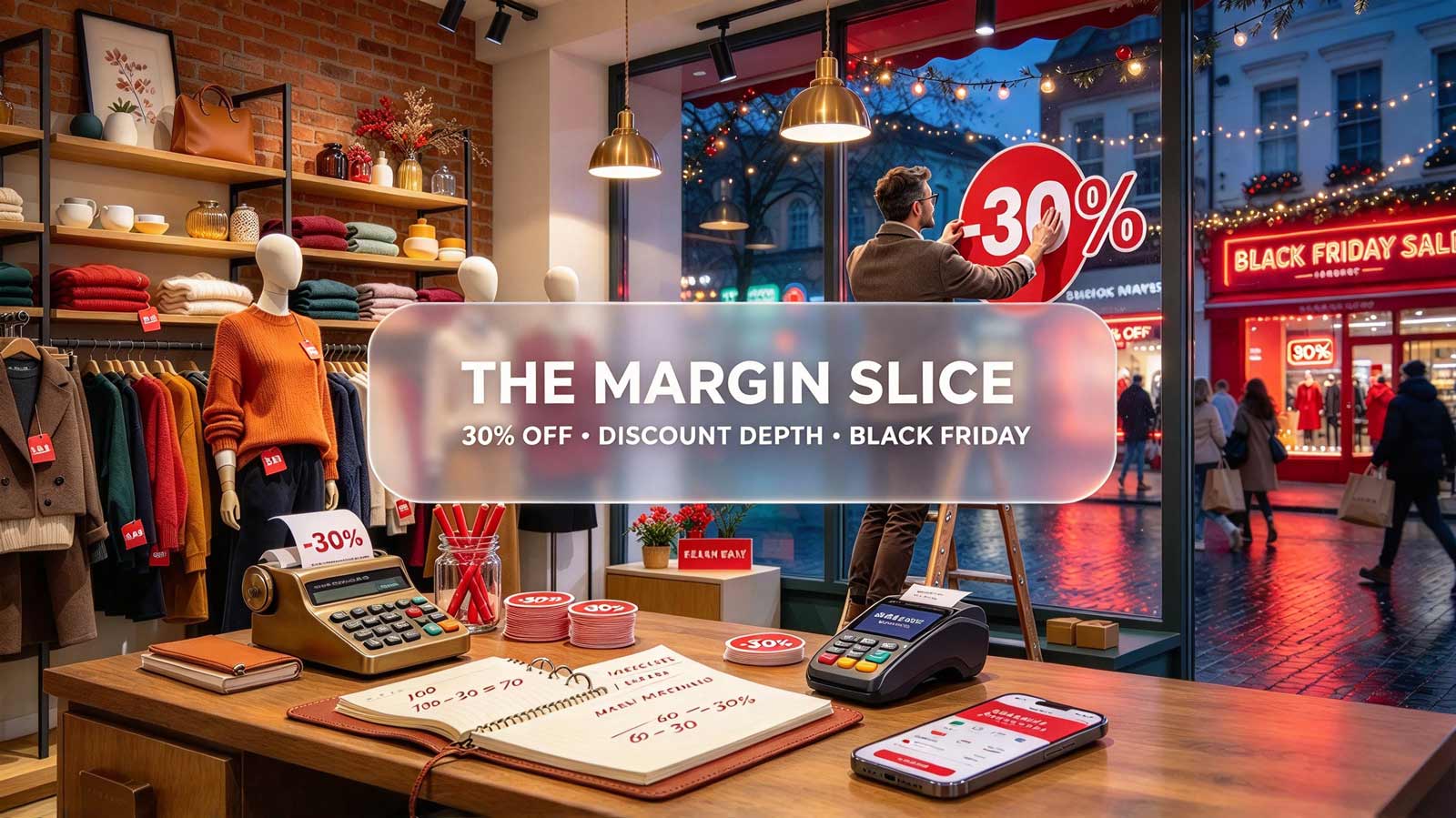
Every discount is paid entirely from the margin slice of the order—never from COGS, never from shipping, never from the ad spend already sunk. That asymmetry is why the math punishes depth so quickly. On a $100 order with 60% gross margin, the store has $60 of gross profit to work with. A 30% markdown gives away $30 of revenue and all of it comes out of that $60 slice: margin dollars per order fall 50%, not 30%. The picture darkens as margins thin:
- At 70% gross margin, a 30% discount removes 43% of gross profit dollars;
- At 60%, it removes 50%—and once fulfillment, payment and ad costs are added back, most of per-order contribution disappears;
- At 50%, it removes 60%, pushing typical cross-border order profiles into negative contribution on discounted units.
The second-order problem is volume math. Because margin per unit falls by half, a store running 30% off must sell roughly twice as many units to hold total profit dollars flat. Doubling BFCM volume requires roughly doubling traffic, ad budget and fulfillment capacity—costs the discount itself must now fund. Stores that model this breakeven multiplier before setting promo depth routinely land on 15–20% as their floor, not 30%.
Benchmark: Discount Depth vs. Margin by Category
Aggregated Q3 2026 promo performance across 2,400+ cross-border stores shows discount tolerance varies sharply by category:
- Apparel and accessories (70–80% gross margin) absorb 20–25% markdowns with contribution intact, but only when size-availability is above 95%—every sold-out size converts margin into returns, not revenue;
- Home and lifestyle (55–65% margin) performs best at 10–15% depth, with gift-with-purchase offers outperforming straight price cuts on AOV and margin simultaneously;
- 3C electronics and smart devices (40–55% margin) see 10% cuts erase 18–25% of margin dollars; for these catalogs, bundle pricing and trade-in credit beat percentage markdowns on every metric tracked.
Behavioral data adds a second filter: deal-depth attracts one-time, return-prone buyers. Orders placed at 30%+ discount show repeat purchase rates 40–60% below full-price cohorts in the following 90 days, and return rates 5–8 percentage points higher—particularly in apparel, where bracketing behavior intensifies under deep markdowns. The discount doesn't just shrink this order; it selects for the customers most likely to erode the next one.
Where Markdown Money Quietly Leaks Across Borders
Cross-border stores face three markdown leakages their domestic competitors don't:
- Duty-inclusive pricing means the discount subsidizes tax. On DDP orders, a 30% cut reduces the product price but duties and clearance fees are typically calculated on the discounted customs value or remain fixed—the store pays the same friction on less revenue.
- Return spikes arrive 3–4 weeks later. Deep-discount orders return at higher rates, and each return lands after peak-season reverse-logistics rates have activated, compounding a margin loss with a logistics loss (the five-layer return cost structure covered in our Store Analysis column).
- Deep cuts reset the price anchor. Post-event conversion routinely drops 10–15% for two to three weeks as full-price pages feel expensive, and returning visitors wait for the next code.
Three Alternatives That Convert Without the Margin Leak
Stores that hit BFCM targets with intact margin tend to use three alternatives before touching list price:
- Threshold economics: "Spend $80, save $12" style offers cost the store 12–15% on qualifying orders only, lift AOV 15–25%, and leave the catalog's price anchor untouched;
- Bundle and gift-with-purchase structures: pairing a hero SKU with a low-COGS accessory delivers perceived value at a fraction of the equivalent markdown cost, while clearing slow movers without a visible price cut;
- Time-boxed value-adds: free shipping upgrades, extended return windows or priority dispatch convert hesitation without touching unit price—and create upsell surface on post-purchase flows, where margin recovery is cheapest.
The common thread: give the customer a reason to feel they won, while the P&L keeps its price integrity. Stores running structured offers at 12–18% effective depth report 85–90% of the conversion lift of 30% blanket markdowns at roughly half the margin cost.
Core Takeaways
- A 30% discount removes 30 points of revenue but 50–60% of margin dollars—the cut is always paid from the margin slice, never from costs.
- Volume must double to offset a 30% markdown at typical DTC margins; model the breakeven multiplier before fixing promo depth.
- Category gross margin sets the ceiling: apparel tolerates 20–25%, home goods 10–15%, 3C under 10%—deep cuts push thin-margin catalogs below zero contribution.
- Threshold offers, bundles and value-adds recover 85–90% of deep-discount conversion at roughly half the margin cost, without resetting the catalog's price anchor.