
Introduction
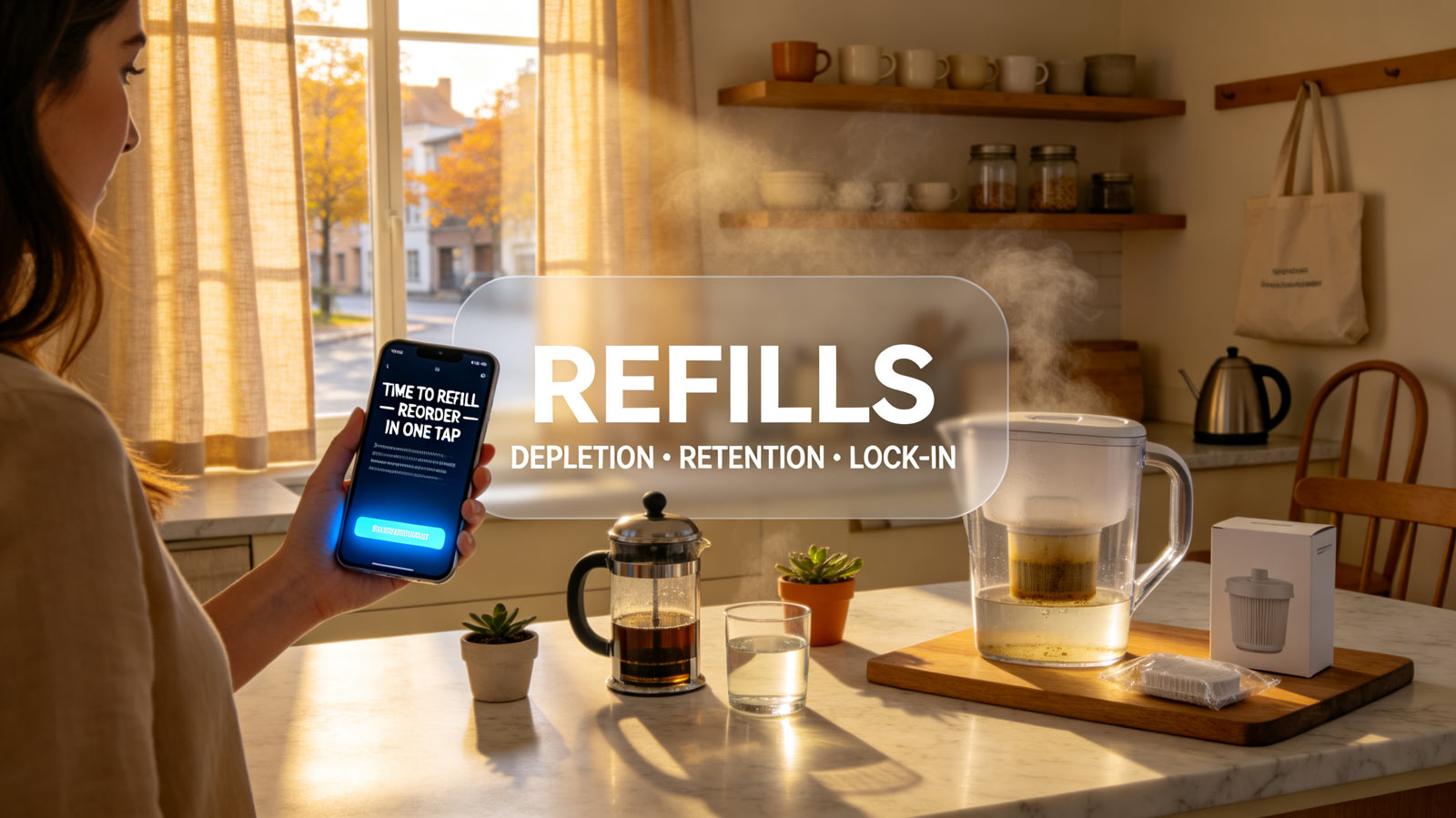
The Corrected Math: Refill Revenue Is Linear and Churn-Dependent
First, fix the arithmetic. A first purchase on day zero with a 45-day depletion cycle produces refills on days 45, 90, 135 and so on. The last refill that fits inside a 365-day year lands on day 360 — that is eight refills, nine orders, 225 dollars of year-one revenue, assuming zero churn. Any article quoting "seven refills" has miscounted the cycle.
The zero-churn ceiling is a fantasy, so the honest model is retention-adjusted. With a per-cycle retention rate r, expected lifetime orders equal one divided by (one minus r) — a geometric sum, meaning each point of retention adds a linear slice of revenue, not exponential growth:
- Retention 50 percent per cycle: about 2 expected orders, roughly 50 dollars of lifetime revenue.
- Retention 70 percent: about 3.3 expected orders, roughly 82 dollars.
- Retention 85 percent: about 6.7 expected orders, roughly 166 dollars.
Against a 25-dollar one-time SKU with identical 40 percent margin, the consumable wins at almost any positive retention — but the margin of victory, and therefore how much CAC you can afford, scales almost entirely with r. This is why "compounds thereafter" is marketing noise: refills stack linearly, and the stacking rate is your entire business model.
Data Sources and Conflict-of-Interest Statement
Four Screening Tests, and How to Lock the Refill
- Depletion test — does it physically run out? Slow-wearing accessories (phone cases) fail; filters, ink, supplements, cleaning refills pass.
- Cycle regularity test — is replenishment predictable? Irregular depletion breaks reminder timing and churns subscribers silently.
- Lock-in test — must the refill come from you? This is the biggest revenue decision in the model, and it is a design decision, not a hope: proprietary non-standard interfaces (custom filter housings, blade mounts, pod shapes) that third-party generics cannot copy; authentication chips or paired serials, the printer-ink playbook; subscription binding at checkout, where the first order ships discounted in exchange for a refill commitment; and refusing to list refill SKUs on open marketplaces, where compatible generics live. A consumable with an open interface leaks its entire refill stream to whoever undercuts you by two dollars.
- Noticeability test — does the customer notice depletion? Hard-stop products (printer ink, water filters) trigger reorders; fade-out products (air fresheners) churn without a signal.
Where the Model Silently Breaks
- One refill stockout resets retention to zero — the habit breaks, and the customer restarts with a competitor; replenishment reliability is a prerequisite, not an optimization.
- Forced subscriptions without a one-time option raise cancellation and chargeback rates; offer both paths.
- Thin first-order margin — consumables are low-priced, so front-end CAC must clear first-order contribution before the loop even begins.
- Shelf-life and compliance — expiry dates, certifications and cross-border rules add costs durable goods never carry.
Core Takeaways
- A consumable is an acquisition channel, not a category — the product re-acquires its own customer, but only if depletion is real, regular, noticeable and locked to your refill.
- The math is linear and churn-driven — eight refills per year is the zero-churn ceiling; at realistic per-cycle retention the expected lifetime revenue ranges from roughly 50 to 166 dollars, and every retention point scales it linearly.
- Lock-in is a design decision — proprietary interfaces, authentication, checkout subscription binding and marketplace exclusion decide whether refill revenue flows to you or to compatible generics.
- Verify with your own cohorts, not our network — retention rates here are illustrative anchors; the model fails or succeeds on your measured per-cycle retention, which no vendor aggregate can supply.