
Introduction
Why Stockouts Get the Attention — but Overselling Gets the Bill
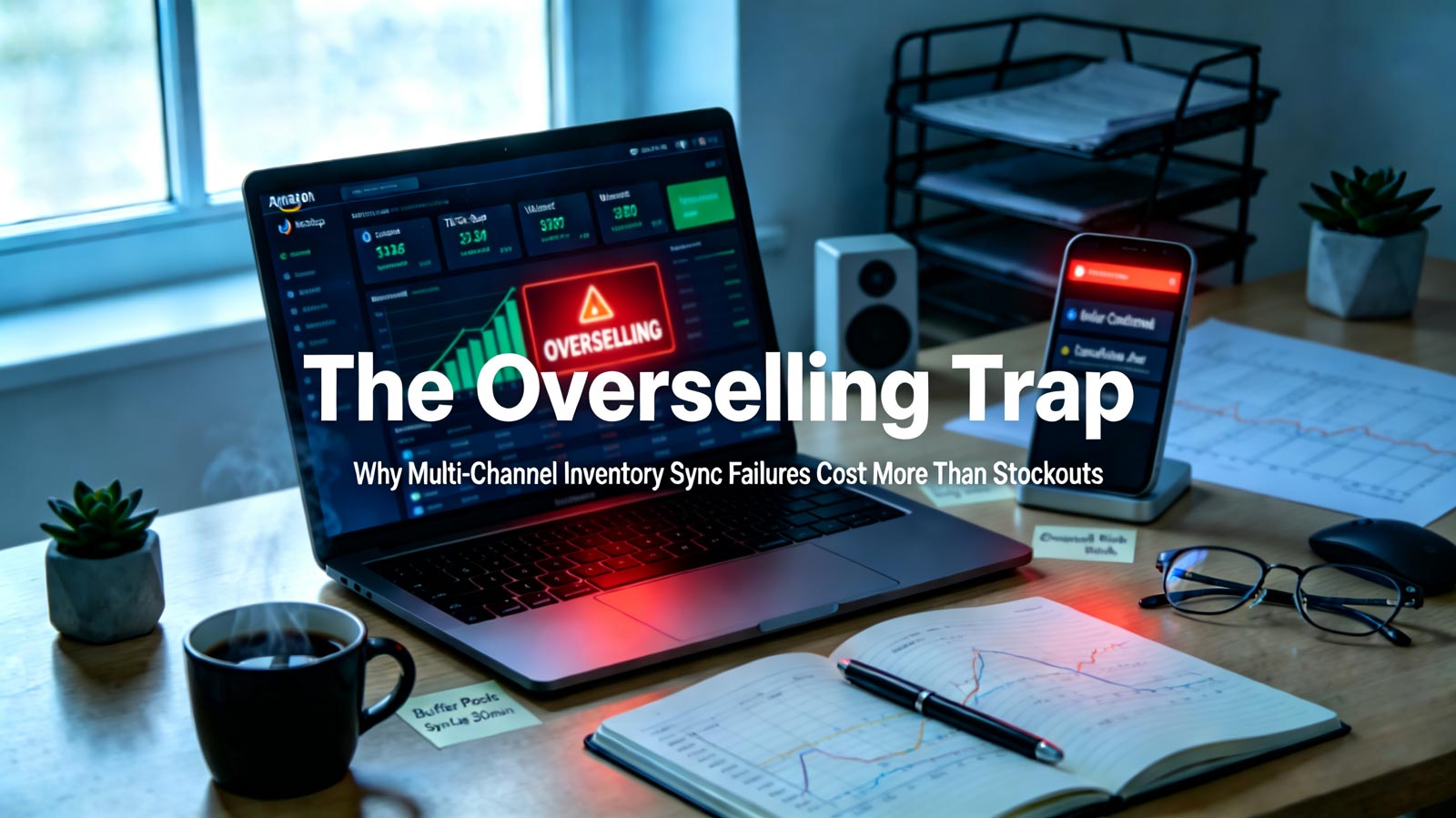
Retail instinct says an empty shelf is the worst outcome. Operationally, the data says otherwise. A stockout costs you a missed sale and a temporary ranking dip. An oversell triggers a cascade: cancellation, refund, negative review, and — on marketplaces — policy strikes against your account health.
The asymmetry is structural. Stockouts cap your upside; overselling actively destroys accumulated trust. A single TikTok Shop oversell event during a live-stream spike can wipe out weeks of organic ranking gains, because conversion velocity is the platform's core ranking signal. Worse, overselling scales with success: the faster you grow, the more channels you add, and the wider your sync gaps become.
Where Sync Breaks: The Four Failure Points
Most overselling isn't a warehouse problem — it's an architecture problem. The four most common failure points we see across cross-border operations:
- Lag-based syncing. Inventory updates batch every 15–60 minutes. During a flash sale or live-stream event, that lag guarantees oversells at peak velocity.
- Channel-pooled stock. Allocating one shared pool across channels with no buffer logic means every channel sees the full quantity simultaneously.
- Return-loop blindness. Items in transit back to the warehouse often show as available, then can't be picked when orders land.
- Multi-warehouse fragmentation. Stock split across three overseas warehouses is invisible to channel-level sync tools that track a single "total."
The Compounding Cost Model
The true cost of an oversell is rarely the refund itself. Our operations benchmarks show the damage stacking across four layers:
- Cancellation fees and refunds: 100% of order value plus processing costs.
- Marketplace penalties: Late-shipment and cancellation-rate thresholds trigger account-level restrictions; repeat violations cap listing visibility.
- Ranking decay: Cancelled orders suppress conversion velocity signals, and recovery typically takes 2–4 weeks of sustained performance.
- Review erosion: Each visible "order cancelled" experience disproportionately generates 1-star reviews, with outsized influence on high-intent buyers.
For a mid-sized cross-border store, 50 oversells per month can translate into a five-figure monthly loss — most of it invisible in standard P&L reporting, because it's distributed across refunds, ads, and lost organic traffic.
A Real-World Pattern: The Live-Stream Spike
The Defensible Architecture: Buffer Pools and Single-Source Truth
The fix isn't more frequent syncing — it's smarter allocation. Leading sellers are moving to a three-layer model:
- Channel-specific buffers: Reserve pools sized by each channel's volatility (TikTok live-streams get the largest buffer), so no channel ever sees the full physical count.
- Real-time warehouse truth: Inventory state updates at the picking event, not the batch cycle, with return-loop items quarantined until physically restocked.
- Automatic de-list triggers: When a SKU breaches its safety threshold, listings pause across channels within seconds — before the next order, not after the next refund.
The 2026 Timing Angle
Core Takeaways
- Overselling costs more than stockouts because it compounds through penalties, ranking decay, and reviews — not just refunds.
- The root cause is usually architecture, not operations: sync lag, pooled stock, return-loop blindness, and multi-warehouse fragmentation.
- Buffer pools by channel volatility, picking-event-level accuracy, and automatic de-list triggers form the defensible 2026 model.
- With marketplace enforcement now algorithmic, the next sync failure will likely hit during peak season — when it costs the most.