
Introduction
Industry Benchmark: Live-Commerce Fulfillment Performance Gap (H2 2026)
- Dispatch latency doubles during unplanned spikes. Sellers without event-mode workflows saw average order-to-dispatch time stretch from 14 hours to 31+ hours on live-event days, breaching TikTok Shop's platform dispatch requirements and triggering visible listing-level penalties.
- Cancellation rates scale with processing delay. Every additional 12 hours of processing delay correlates with a measurable rise in buyer cancellations on social-commerce orders — where purchase intent is impulse-driven and buyers reverse decisions quickly.
- Prepared sellers convert spikes into compounding gains. Stores running event-mode fulfillment maintained sub-24-hour dispatch during 10x spikes and converted event buyers at 2.1x the repeat-purchase rate of standard traffic, because fast delivery validates the impulse purchase.
Three Structural Failure Points When Order Spikes Hit
Failure Point 1: Cut-Off Time Collisions
Live streams are scheduled for evening peak engagement — precisely when warehouse cut-off times for same-day dispatch have already passed. An order placed at 20:30 during a high-converting stream sits unprocessed until the next morning's wave, while the buyer's expectation — set by the stream's energy and platform norms — is next-day handling. The mismatch is invisible in weekly averages and glaring in event-day reviews.
Failure Point 2: Shared Inventory Pool Depletion
Most sellers running streams alongside their standard store draw from a single, unsegmented inventory pool. A spike that clears the pool mid-stream triggers overselling within the event itself — the worst possible moment, with thousands of live viewers watching stock counters and checkout errors in real time. (For the underlying sync mechanics, see our multi-channel inventory analysis in this column; the event context adds a speed dimension the standard framework doesn't cover.)
Failure Point 3: Carrier Capacity Assumptions
Daily carrier pickup allocations are sized for baseline volume. A 10x evening surge doesn't just strain the warehouse — it exceeds the parcel carrier's same-day collection capacity, pushing event orders into next-day or multi-day backlogs regardless of how fast they were picked and packed.
The Event-Mode Readiness Playbook
- Ring-fenced event inventory. Before each confirmed stream, allocate a dedicated event stock buffer separate from the daily sales pool, sized from projected viewership and historical conversion. The pool syncs to the channel in real time and deactivates automatically when depleted.
- Extended processing windows. Negotiate event-day handling extensions with your 3PL in advance — shifted pick waves or evening runs covering the stream window plus two hours, targeting same-evening or pre-noon-next-day dispatch for all event orders.
- Pre-positioned regional stock. For repeat event SKUs, position buffer inventory in regional fulfillment nodes near the primary audience. Shorter last-mile legs absorb spikes that would overwhelm single-node operations during Q4 saturation.
- Post-event replenishment triggers. Set reorder triggers at 50% event-pool depletion, not zero. With 2–4 week replenishment lead times, waiting for depletion turns every subsequent stream into a stockout risk — and a cancelled stream slot is often unrecoverable.
Suggested Review Items Before Your Next Live Event
- Confirm event-day processing capacity and cut-off extensions with your fulfillment partner in writing, at least 72 hours pre-event
- Verify real-time inventory sync latency between your warehouse pool and TikTok Shop listings
- Audit historical event data: conversion per 1,000 viewers, peak orders per minute, cancellation rate by dispatch time
- Segment event SKUs from daily stock pools and set depletion alerts at 50%
- Pre-book carrier surge capacity or confirm multi-carrier failover for event days
Core Takeaways
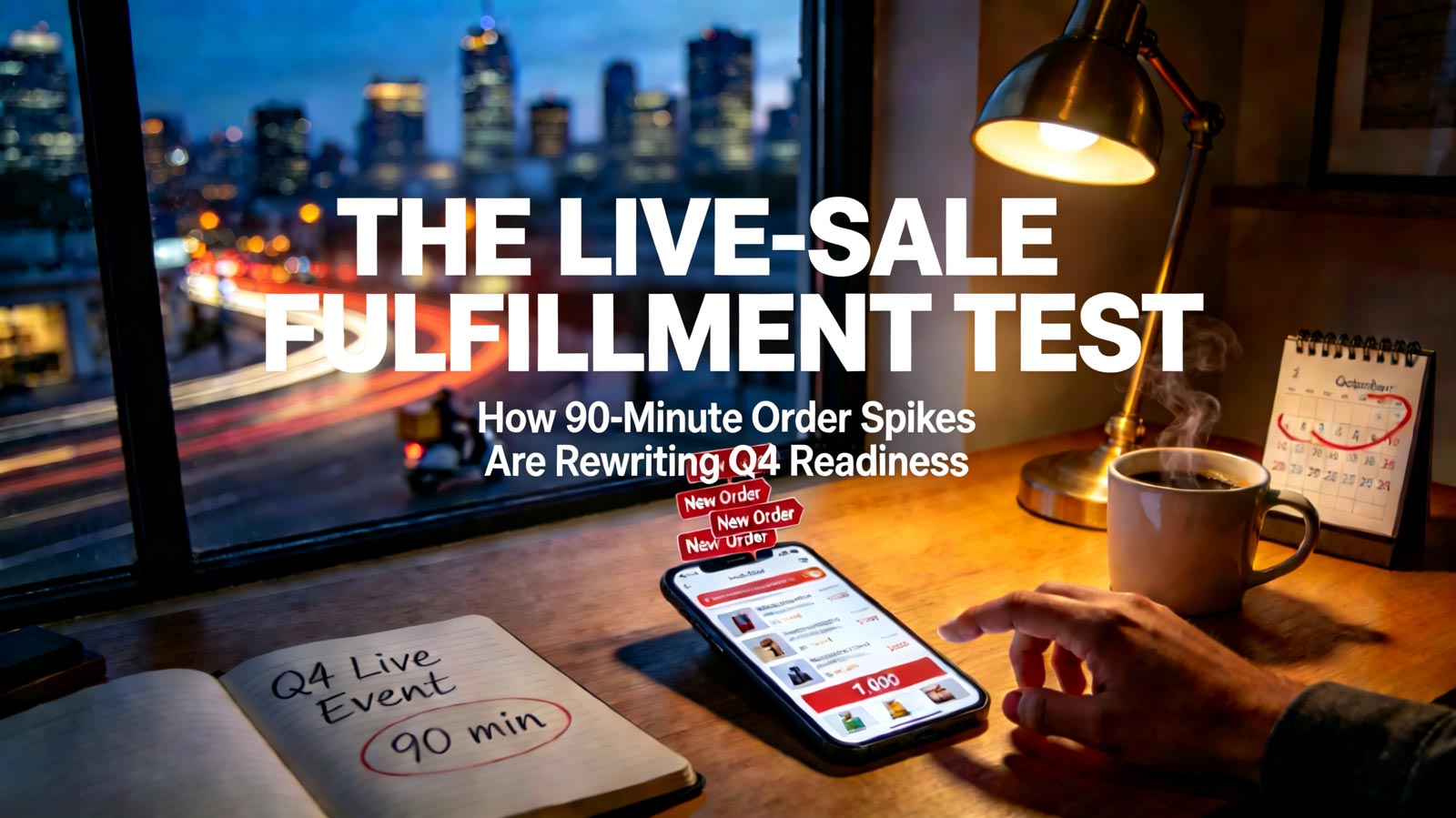
- Over 40% of live-event GMV concentrates in a 90-minute window that conventional, steady-state fulfillment architecture cannot absorb.
- The three failure points — cut-off collisions, shared-pool depletion, and carrier capacity assumptions — are structural, not situational; they recur every event until fixed.
- Event-mode fulfillment (ring-fenced inventory, extended processing windows, regional pre-positioning, early replenishment triggers) converts spikes into repeat buyers instead of cancellations.
- As Q4 live-shopping volume peaks, fulfillment readiness is now a precondition for social-commerce growth — not a back-office afterthought.