
Introduction
The Hidden Downside of Chasing Broad Best‑Sellers
Popular, mass‑market best‑selling products appear low‑risk on the surface. They already have proven market demand, abundant supplier options and clear consumer interest. Yet most brands that jump onto these items quickly run into predictable pain points.
Competition becomes extremely saturated. Multiple retailers list identical or near‑identical SKUs, triggering price wars that steadily erode profit margins. Paid ad costs rise sharply because every competitor targets the exact same broad keywords. Customer loyalty is weak; shoppers purchase based on price rather than brand connection and will switch retailers the moment they spot a cheaper offer.
Over‑reliance on high‑volume broad SKUs also creates unstable store revenue. Once market trends shift or big‑box sellers slash pricing, your top product revenue can collapse very quickly.
What Defines a True Winning High‑Intent Product
A winning high‑intent product does not need thousands of monthly sales to move the needle for your store. Instead, it satisfies four core criteria:
1. Clear, specific customer‑problem fit The item solves one well‑defined pain point for a distinct group of shoppers, rather than trying to appeal to everyone. Buyers are actively searching for a solution before they land on your listing.
2. Built‑in differentiation from mass‑market alternatives Differentiation can come from improved function, material quality, unique design, curated bundling or niche feature sets. This removes direct head‑to‑head price comparison against generic competitors.
3. Sustainable, healthy baseline margins Strong gross margins leave enough budget for ads, content creation, customer support and unexpected supply‑chain costs, without needing extreme sales volume to turn a profit.
4. Strong repeat‑purchase or cross‑sell potential Winning products act as entry‑points into your wider catalog. They attract customers who are likely to explore your other collections and become long‑term buyers.
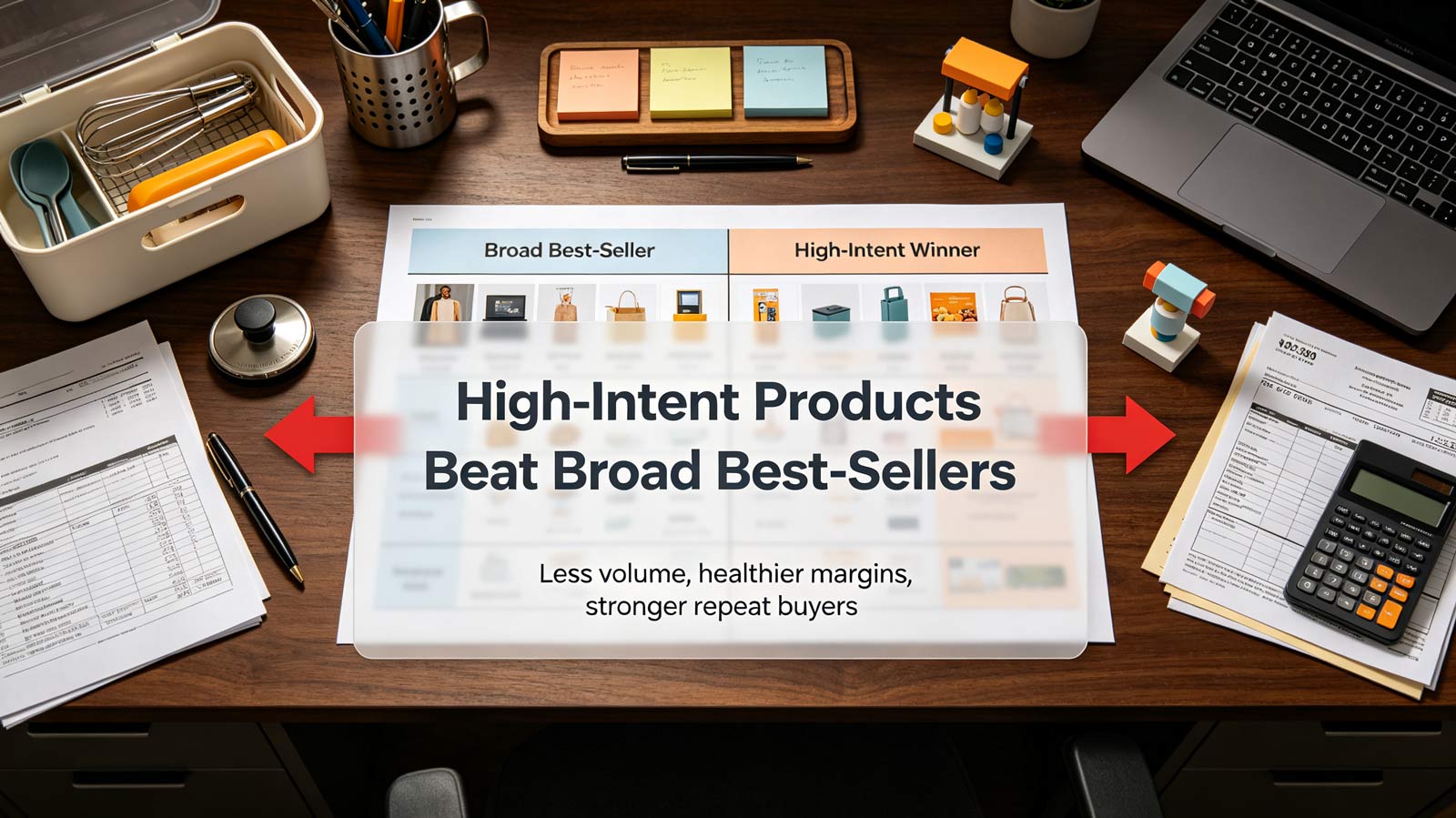
Benchmark Comparison: Broad Best‑Seller vs High‑Intent Niche Winner
We compared performance metrics across 68 home‑goods DTC stores during Q2–Q3 2026.
- Broad best‑seller: Average gross margin 19 %, average customer retention rate 8 %, average cost‑per‑acquisition $4.20
- High‑intent niche winner: Average gross margin 38 %, average customer retention rate 21 %, average cost‑per‑acquisition $2.70
While broad products generated higher unit sales in the first 30 days, high‑intent niche SKUs delivered superior long‑term profitability and far‑more stable traffic.
Three‑Phase Winning‑Product Validation Sprint
This phase‑based workflow helps you identify and test high‑intent winning products before committing to large inventory orders.
Phase 1: Intent‑Driven Opportunity Scan (Week 1) Skip generic best‑seller charts. Research search queries, community discussions and customer feedback to uncover unsolved pain‑points within your existing audience. Document search volume, competitor saturation levels and estimated margin ranges. Create a shortlist of 3‑5 candidate products built around specific user needs.
Phase 2: Low‑Risk Concept Validation (Week 2‑3) Test interest before bulk purchasing. You can run lightweight landing‑page ads, share concept previews to your email list or launch a small pre‑order campaign. Track click‑through rates, add‑to‑cart behaviour, customer questions and conversion intent, rather than judging success purely by immediate sales numbers. Eliminate candidates with weak buyer interest.
Phase 3: Optimised Launch & Performance Monitoring (Weeks 4‑6) Roll out your validated winning product with messaging focused on the specific problem it solves, not just features. Track margin health, customer feedback, repeat‑buy signals and organic search growth. Fine‑tune your listing, creative assets and cross‑sell bundles to maximise long‑term value. Gradually scale inventory as consistent demand emerges.
Common Mistakes When Sourcing High‑Intent Winning Products
- Over‑nicheing beyond viable market size Too‑narrow products can have passionate but far‑too‑small audiences. Always cross‑check that enough active buyers exist to hit your minimum revenue goals.
- Building product messaging around features, not buyer pain points Even the best high‑intent item will under‑perform if your store copy focuses only on materials and specs. Frame every listing around the problem the shopper wants resolved.
- Abandoning new niche SKUs too early Unlike viral best‑sellers, high‑intent winning products often build momentum slowly. Allow sufficient time for targeted audiences to discover your item before judging it unsuccessful.
Real‑World Store Example
A mid‑sized US‑based home‑goods DTC store previously built its catalog around three widely popular, high‑volume storage SKUs. Baseline metrics showed thin margins, rising ad spend and falling repeat rates.
The brand ran the validation sprint above and replaced one saturated best‑seller with a high‑intent niche storage product built specifically for small‑apartment kitchen organisation.
After 60 days, gross margin on the new winning SKU rose from 17 % to 36 %. Repeat purchase rate among its buyers increased from 9 % to 23 %. Initial launch traffic was lower than the old best‑seller, yet conversion quality improved dramatically. A temporary 4 % drop in overall unit sales during transition was quickly offset by higher‑profit revenue growth.
Core Takeaways
- High raw sales volume alone does not make a product a long‑term winner; saturated best‑sellers often trap brands in low‑margin competition.
- High‑intent niche products deliver healthier margins, stronger customer loyalty and reduced price‑war risk for DTC stores.
- Winning‑product discovery should prioritise shopper pain‑point research over generic trending product lists.
- A structured three‑phase validation sprint reduces inventory risk and helps you reliably identify profitable winners before large commitments.