
Introduction
The Short Answer: H2 2026's most profitable DTC SKUs no longer win on low price or basic functionality alone. Top‑performing stores prioritize functional utility + interactive experiential value: practical everyday goods layered with DIY customization, sensory engagement, or companionship‑driven interaction. This dual‑value formula drives higher AOV, lower return rates, and healthier inventory turnover — perfectly aligning with the capital‑efficiency and vertical benchmark standards covered in our prior store and industry analysis.
Based on Globe Fulfillment's H2 2026 merchant performance data covering 10K+ DTC stores, commodity‑style pure‑function SKUs are seeing shrinking margins and rising stock pressure, while products with layered experiential features deliver 19% higher average gross margin and 22% faster 90‑day turnover. This article breaks down three hybrid‑value verticals validated by that data — and how to stock them for Q4.
The 2026 DTC Product Shift: From "Pure Utility" to "Engaging Functionality"
Ordinary functional goods have been commoditized: social trend cycles are compressing and mass‑market supply is saturated, leaving generic SKUs trapped in price wars with sluggish turnover. (For a parallel read on how home‑category demand itself is shifting in 2026, see our Industry Insights analysis of the "de‑houseworking" consumer.)
The result is a clean market split: generic functional goods occupy low‑margin, slow‑turn slots, while functional + experiential hybrids hold high‑margin, fast‑turn positions — the standard this article applies to all three verticals below.
Three Hybrid‑Value Verticals (H2 2026 Data Verified)
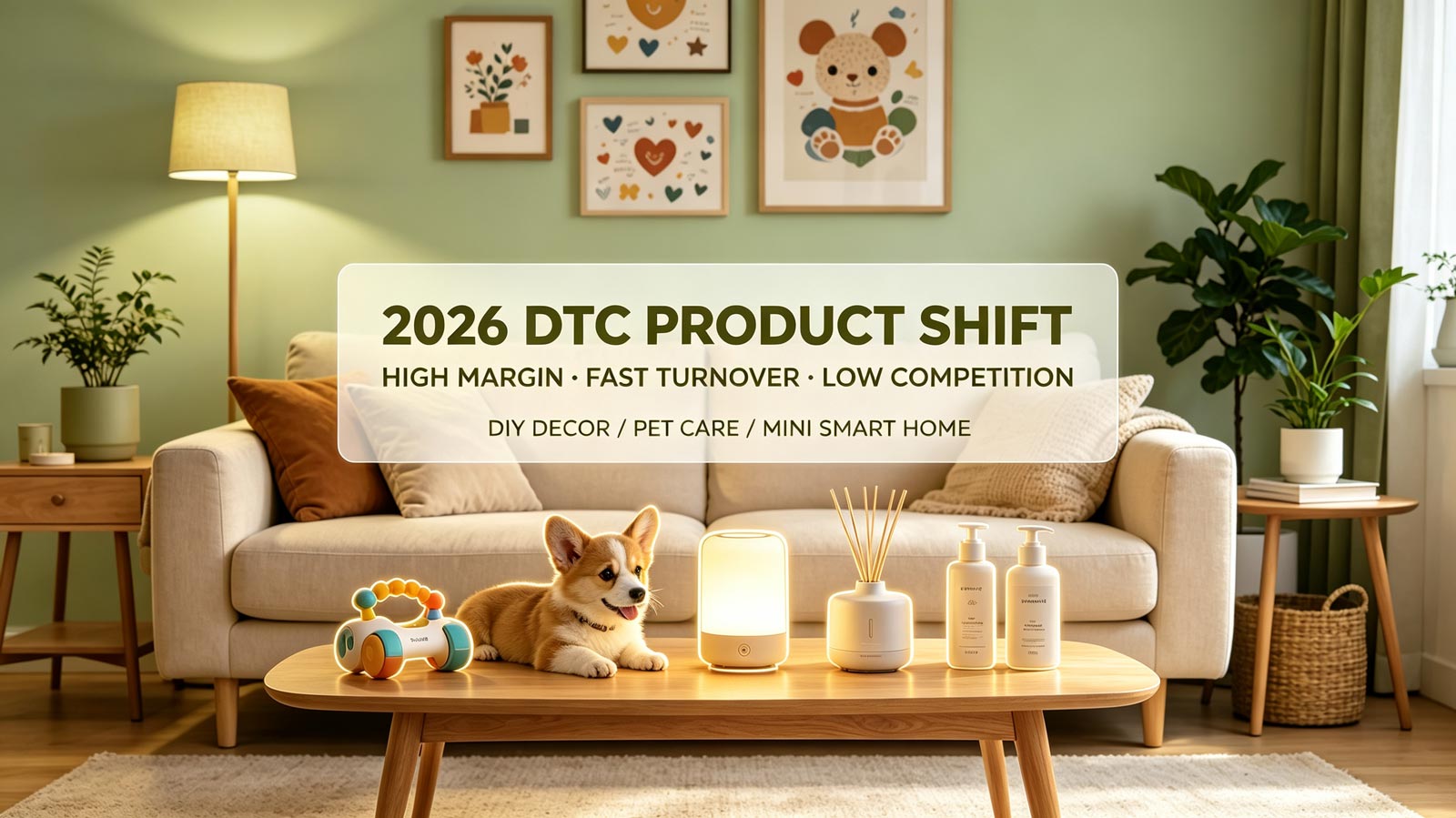
Below are three low‑competition, high‑profit verticals sustaining stable DTC growth in late 2026, each pairing a clear functional base with an experiential layer. All three are replicable product profiles ideal for Q4 peak‑season stocking and long‑term portfolio optimization.
1. DIY Functional Decor — the Creative Leisure Angle
Mass‑produced ordinary home decor is severely oversupplied with diminishing profit margins. By contrast, DIY assembly, customizable, and interactive decorative kits maintain consistent sales growth and premium pricing power. TikTok and social platform data show 17% of global consumers now prioritize "creatable" products that deliver hands‑on engagement and personalized end results.
Critically, these products sell as creative leisure, not household utility. Consumers buy them for the experience of making — which is precisely why they escape both the commodity price war and the "de‑houseworking" demand shift squeezing purely aesthetic decor.
Standout traits:
- Dual value of hands‑on creative engagement and a finished, displayable result
- Strong social sharing potential ("I made this")
- Lightweight volume with low warehousing and logistics pressure
- These SKUs naturally sustain high turnover rates and avoid legacy stock capital crowd‑out risks
- Price band: 24.99‑59.99
- Gross margin: 50–65%
- Return rate: under 4% when clear assembly instructions are included
- Average parcel weight: under 500g, keeping per‑order logistics cost low
- Demand: stable year‑round with a Q4 gift‑assembly spike
The pet category remains one of the few DTC verticals with near‑zero trend‑cycle risk: demand is anchored in daily care routines rather than social spikes, and repurchase behavior is structurally high.
Standout traits:
- Clear functional base (feeding, grooming, cleaning) upgraded with experiential layers — interactive puzzle toys, pet photography props, and seasonal costumes that owners actively share on social platforms
- Lightweight SKUs with strong subscription and refill potential keep 90‑day turnover well above category benchmarks
- Price band:15.99‑49.99
- Gross margin: 45–60%
- Return rate: under 3% (no size/fit friction for toys and accessories)
- Repurchase rate: above 18%, the highest of the three verticals here
- Demand: stable year‑round with gifting spikes around the December holidays
Large‑scale smart home devices face high logistics costs, high return rates, and fierce market competition. Compact, portable mini functional gadgets focused on ambient home experience and personal light wellness maintain steady evergreen demand, unaffected by fleeting social trends.
- Stable long‑term demand with iterative functional upgrades and minimal trend volatility
- Compact form factors keep shipping costs and return logistics manageable
- Price band:29.99‑79.99
- Gross margin: 40–55%
- Return rate: 3–5%, driven mainly by unclear voltage/plug labeling in EU markets — a documentation fix, not a product defect
- 90‑day turnover: 4.0–5.5×, in line with our H2 2026 3C and home‑goods vertical benchmarks
Why Hybrid‑Value SKUs Outperform Generic Commodities
- Superior capital efficiency: Dual‑value products generate stable gross profits without long‑term warehouse capital occupation. In our dataset, hybrid SKUs hold 90‑day turnover 22% above pure‑function peers at equal price points — fully matching SKU ROIC evaluation standards.
- Reduced inventory risk: Differentiated experiential value avoids homogeneous price competition. None of the three verticals above showed trend‑driven stock write‑downs in H2 2026.
- Improved compound sales: Customizable and bundable attributes naturally lift store AOV — bundle and customization attach rates average 30%+ across hybrid SKUs — optimizing overall inventory turnover performance.
H2 2026 High‑Performance SKU Selection Checklist
- Verify 90‑day turnover compliance with vertical benchmark thresholds before bulk procurement
- Prioritize SKUs with layered functional and experiential dual value — see the three verticals above for reference profiles
- Avoid purely viral trend items; validate 90‑day turnover against our H2 2026 vertical benchmarks before Q4 commitments
- Evaluate new SKUs via ROIC metrics instead of gross margin alone to optimize capital allocation
Fulfillment Notes for Hybrid‑Value SKUs
Dual‑value SKUs carry higher per‑unit value, making overseas warehouse stocking more capital‑efficient per cubic meter.
- For Q4 inventory layout, inbound shipments should arrive at US and EU warehouses by mid‑October to capture peak‑season pricing.
- Multi‑component sets (DIY kits, pet bundles) benefit from component‑level inventory tracking to avoid residual stock of individual parts — the same rule our bundle analysis applies to seasonal sets.
Margin Disclaimer
Core Takeaways
- 2026's top‑performing DTC products adopt a functional plus experiential dual‑value formula, outperforming pure commodity SKUs by 19% in gross margin and 22% in 90‑day turnover.
- DIY creative‑leisure decor, pet interaction & care products, and mini smart wellness gadgets are the most stable high‑growth verticals for late‑2026 store stocking.
- Scientific product selection must align with inventory capital efficiency rules and vertical turnover benchmarks to eliminate silent profit loss.
- Differentiated experiential value resists market saturation and mitigates peak‑season overstock risks。