Introduction
Most home‑goods brands default to one reliable fix whenever bundle sales stall: add a percentage‑off discount. For many merchants, 15%, 20% or 25% off bundle pricing has long been their go‑to lever for clearing inventory and lifting conversion.
Yet our 2026 store audits identify a widespread, under‑diagnosed revenue trap: bundle‑level discount fatigue. Repeated discounting slowly erodes bundle perceived value, while delivering shrinking incremental conversion gains over time.
This Store Analysis is distinct from our earlier reports covering checkout abandonment triggers and mobile UI friction. Those audits solved problems caused by stock, policy, account requirements or mobile‑interface barriers.
Today’s case study focuses purely on promotional behaviour: what happens when your discount strategy itself becomes the bottleneck to bundle growth. We break down measurable fatigue signals, three common merchant misdiagnoses, a complete before‑and‑after store case study, and a non‑discount playbook to rebuild bundle momentum.
Core Discovery: The Diminishing‑Returns Curve for Bundle Discounts
Single‑item promotions tend to retain consistent lift for longer. Bundle shoppers, by contrast, build expectations around discounted pricing very quickly. Once buyers learn to wait for percentage‑off events, baseline bundle conversion falls and every subsequent promotion requires deeper discounts just to hit the same sales volume.
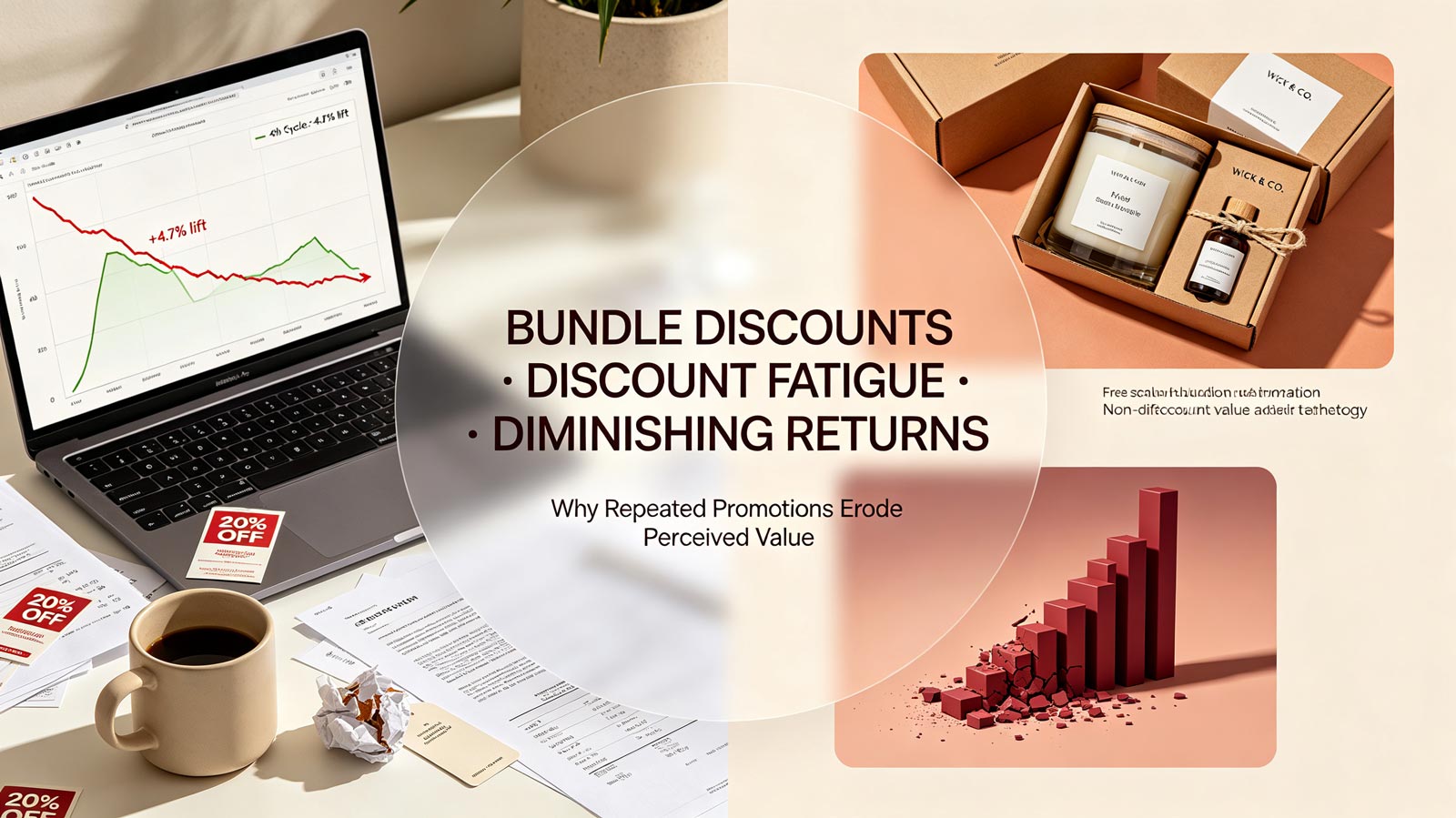
Across our audit sample, stores running bundle discounts more frequently than every 45 days saw their promotional conversion lift shrink sharply. On average, the first 20%‑off bundle campaign delivered +21.4% volume gain. By the fourth identical 20%‑off cycle, that same promotion only moved the needle by +4.7%.
Profit margins collapsed in lockstep, with no corresponding improvement to long‑term repeat purchase rates.
The gap between baseline conversion and promotional‑only sales widens over time. Stores become trapped in a cycle: they cannot hit revenue targets without running discounts, and cannot afford to keep running them.
Four Clear Audit Signals That Your Bundles Suffer From Discount‑Dependence
Signal 1: Flat baseline bundle conversion between sales Red flag: Baseline (non‑promo) bundle conversion stays below 2% for 30+ consecutive days while promotional conversion exceeds 6%. Shoppers delay full‑price purchases and wait for the next offer.
Signal 2: Diminishing lift on identical discount depth Red flag: The same discount depth delivers less than 50% of its first‑cycle volume gain on the third or fourth repetition. Your promotion spends more for far‑weaker results.
Signal 3: High promotional‑only buyer concentration Red flag: 55% or more of bundle transactions occur during discount windows, with standard‑price sales dropping month‑over‑month. Very few customers purchase bundles at regular price.
Signal 4: No sustained post‑promotion lift in repeat rate Red flag: Repeat‑purchase rate for discount‑acquired buyers remains within 2 percentage points of baseline after 60 days. Discount‑driven buyers are not converting into loyal, long‑term customers.
Top 3 Merchant Misdiagnoses (Why Brands Keep Pouring Money Into Failed Discounts)
Most stores misread discount fatigue as a product or traffic problem, causing them to double‑down on promotions instead of fixing the root issue.
Misdiagnosis 1: “Our bundle pricing is too high.” Reality: Your price point is not the barrier. Session data shows visitors add bundles to cart, then exit and wait for a sale alert. Shoppers are not rejecting value; they are trained to delay.
Misdiagnosis 2: “We need deeper discounts to spark interest.” Reality: Cutting to 30% or 35% off delivers only a temporary bump. It accelerates value erosion and resets shopper expectations at an even lower price floor.
Misdiagnosis 3: “Our bundle lacks appeal; we need new components.” Reality: Bundle‑page view‑to‑cart rates remain healthy. The problem happens at checkout, where purchase decisions become promotion‑dependent rather than value‑dependent.
Scaled Fix Playbook: Non‑Discount Strategies To Break Fatigue
These fixes are grouped by store size, so you can phase out over‑reliance on percentage‑off offers without shocking your monthly revenue.
Small‑to‑mid stores (<1200 monthly orders)
Pause scheduled repeating percentage‑off bundle cycles. Replace blanket discounts with bonus‑add‑on rewards: free small accessory, extended shipping window, or early access to new bundle releases. Value‑add rewards preserve perceived bundle price while giving shoppers an incentive to buy now.
Mid‑to‑large stores (>1200 monthly orders)
Segment your audience. Offer percentage‑off promotions only to first‑time cold traffic, while building full‑price incentives for returning visitors. Separate your bundle calendar: limit site‑wide bundle discounts to a maximum of three windows per year. Fill the rest of your promotional calendar with bundle‑exclusive perks rather than price cuts.
Verified 30‑Day Store Optimization Case Study
Store Background: Take Wick & Co. — a Denver‑based candle and home fragrance brand with 17 SKUs, roughly 1240 monthly orders. Over six months, the brand ran bi‑monthly 20%‑off bundle promotions. Baseline bundle conversion had dropped to 1.8%, and 62% of all bundle sales occurred during discount events. Two rounds of deeper discounting failed to restore healthy margins.
Pre‑Optimization Baseline Baseline bundle conversion (no promotion live): 1.8% Share of bundle sales driven by discount events: 62% Average bundle profit margin during promotions: down 9.4 percentage points Repeat‑purchase rate for discount‑acquired bundle buyers: 7.1%
Targeted Non‑Discount Fixes Applied Canceled recurring bi‑monthly 20%‑off bundle campaigns Replaced percentage‑off incentives with free scent‑sample add‑ons for bundle purchases Added a “bundle early‑bird preview” perk for email subscribers, no price reduction Ran zero blanket site‑wide bundle discounts for the full 30‑day audit window
30‑Day Verified Results Baseline (non‑promo) bundle conversion rose from 1.8% to 3.1% Discount‑driven bundle sales share dropped from 62% down to 34% Overall bundle profit margin increased by +7.6 percentage points Repeat‑purchase rate of new bundle buyers improved to 11.8%
Notably, total unit sales dipped slightly in the first 10‑day adjustment window, before recovering and surpassing pre‑test volume as full‑price buyer behaviour returned. Their operations lead put it bluntly: “We were training customers to ignore us until we sent a sale email.”
Core Takeaways
1. Repeated percentage‑off bundle promotions trigger discount‑dependence, creating a shrinking‑lift trap that erodes baseline conversion and margins over time.
2. Deeper discounts are rarely the solution to slow‑moving bundles; they only reset shopper expectations to a lower price floor.
3. Value‑add, non‑price incentives rebuild full‑price buying behaviour, without sacrificing long‑term bundle perceived value.