
Introduction
Most cross-border merchants fall into a homogeneous operational dilemma: they chase high-search-volume mainstream keywords, secure stable daily orders, but struggle to raise profit margins. Mature core keywords come with saturated bidding costs, fierce price competition, and diminishing marginal returns on advertising.
Different from conventional saturated product research logic, this guide focuses on long-tail demand mining — a low-risk, sustainable SKU development method. We elaborate on step-by-step executable channel operations, explain how to measure keyword competition, classify long-tail keywords by user purchase intent, match differentiated development strategies for merchants of different scales, outline clear trial-sale elimination standards for underperforming items, and share a complete data-driven SKU case from 0 to launch. This framework helps brands tap untapped niche traffic, reduce advertising reliance, and lift profits while acknowledging inherent limitations and risks of long-tail product layouts.
Merchandising Background: Hidden Bottlenecks of Mainstream Keyword Layout
Building product lines entirely around broad mainstream keywords leads to two unavoidable long-term operational pain points.
First, homogeneous competition crushes profit margins. Mass merchants launch highly overlapping SKUs for the same core keywords, leaving buyers with no other decision basis except price. Store conversion relies on low-price strategies, forming a vicious cycle of profit compression.
Second, traffic is completely dependent on paid ads. Mature mainstream products have extremely limited natural search ranking space. Merchants must continuously increase ad budgets to maintain basic visitor volume, resulting in rising customer acquisition costs and stagnant net profits.
Long-tail keywords represent segmented, precise, scenario-based consumer demands. When matched with properly screened low-competition search phrases, corresponding SKUs connect with users holding clear purchase intentions and fewer rival listings. That said, long-tail layouts carry inherent drawbacks: individual keywords carry limited search volume with hard traffic ceilings, and demand often fluctuates sharply with seasons, trends and consumer lifestyle shifts. Relying solely on long-tail products cannot replace mainstream core SKUs as the store’s primary revenue source.
Four Executable Long-Tail Keyword Mining Channels
All four channels below are 100% free, suitable for independent store beginners and small teams, with clear operation paths to solve the problem of “knowing the theory but not the practice”.
Channel 1: Store Background User Search Records
This is the most accurate internal demand source, reflecting real search behavior of your existing store traffic.
Exact Operation Path:Shopify backend → Analytics → Search terms, directly export all visitor search records of the last 30 days; WooCommerce users can download search keyword data via the official Search Analytics plugin. Filter unqualified short words and brand words, retain descriptive long-tail phrases with scenario, function or crowd attributes.
Core Value: Mined demands align closely with your store’s existing product positioning, typically delivering relatively high conversion potential.
Channel 2: Platform Q&A & Community Discussion Content
Amazon Q&A, Reddit niche communities, Facebook group discussions, and product review sections contain a large number of user-spoken demand descriptions. These details are rarely captured by professional keyword tools and cover real usage pain points.
Operation Tip: Focus on high-frequency repetitive questions and negative review descriptions of mainstream bestsellers, which are the core sources of pain-point long-tail keywords.
Channel 3: Search Engine Related Searches & AI Auxiliary Suggestions
Exact Operation Tool: Use Google bottom related searches, People Also Ask modules, combined with AI tools including ChatGPT and Perplexity. Input core industry keywords + “user search queries”, “niche usage scenarios”, “common product complaints” to expand massive extended long-tail words.
Core Value: Capture potential users in the information collection stage, expand pre-purchase traffic sources, and identify emerging trending demands ahead of competitors.
Channel 4: After-sales Consultation & Customer Service Records
Classify and sort 30-day customer service consultation records, focusing on repeated questions about product functions, applicable scenarios, matching accessories, and crowd adaptation. Most consultation problems correspond to unmet niche demands, which can be directly converted into long-tail SKU optimization directions.
How to Evaluate Real Competition Level for Long-Tail Keywords
The term “low-competition long-tail keyword” cannot be judged by length alone; merchants need to cross-verify through three practical, accessible dimensions before developing supporting SKUs:
Keyword Difficulty (KD) score
Use free tools such as Google Keyword Planner or Ubersuggest to check KD values. Phrases with KD below 30 have mild ranking competition and suit small independent stores; KD above 40 indicates numerous mature competing listings, requiring extra differentiation investment to stand out.
SERP homepage competitor audit
Input the full long-tail phrase into Google and inspect the top 10 organic results. If over half are large brand official websites or top Amazon listings with thousands of reviews, the niche is far more competitive than it appears. Ideal low-competition phrases feature most results from small niche blogs, small independent stores and low-review marketplace listings.
Paid advertising bid reference
Check the average CPC of the keyword in Google Ads. Steady high bids above the industry average signal many sellers are already targeting this search demand, eroding potential profit margins for new entrants.
Three Long-Tail Keyword Categories & Matching Differentiated SKU Development Directions
We summarize clear one-to-one demand and product iteration matching logic to guide precise long-tail SKU development:
Type 1: Scene-based Descriptive Long-Tail Keywords
Feature: Carry specific usage environments, usage timing, and matching scenarios. Development logic: Adjust product specifications, accessory combinations, and packaging sets for fixed scenarios to form lightweight differentiation without large-scale R&D investment.
Type 2: Pain-point Oriented Long-Tail Keywords
Feature: Clearly point out the defects and deficiencies of mainstream products. Development logic: Targeted optimization of single pain points (such as storage inconvenience, insufficient compatibility, single function) to solve user core pain points and build mild competitive barriers.
Type 3: Crowd-exclusive Long-Tail Keywords
Feature: Lock segmented groups (age, occupation, usage habits). Development logic: Adjust product parameters, operation difficulty, and appearance design to adapt to the usage habits of specific crowds and avoid crowding into mainstream public demand tracks.
Differentiated SKU Strategies for Different Merchant Scales
Small Single-Category Merchants
Prioritize scene-based long-tail keywords, rely on existing mature SKUs for micro-optimization (accessory replacement, specification adjustment, scene packaging), avoid new mold development, control trial stocking risk, and quickly verify niche demand. Given limited operational bandwidth, small teams should only launch 3–5 long-tail variants per test cycle to avoid scattered inventory investment.
Multi-Category Brand Merchants
Layout all three types of long-tail SKUs simultaneously: iterate scene differentiated variants, launch pain-point upgraded versions, and develop crowd-exclusive series. Establish a quarterly keyword update mechanism to continuously output new niche products. Brands must allocate separate inventory budgets for long-tail items and avoid diverting stock from core mainstream bestsellers.
Four Common Long-Tail Research Biases
Many merchants fail in long-tail layout not due to insufficient demand, but wrong research logic:
Bias 1: Abandon low-traffic single long-tail words
A single long-tail word has low daily search volume. While batches of segmented long-tail SKUs can accumulate steady incremental orders, merchants should not over-rely entirely on these low-volume phrases to drive core store revenue.
Bias 2: Blind micro-modification without matching core demand
Simple appearance adjustment cannot solve user pain points reflected by long-tail keywords. Disconnected product optimization leads to low matching degree and poor conversion effect.
Bias 3: Overlay multiple unrelated demands on one SKU
Excessive functional superposition increases production costs, confuses product positioning, and reduces the precision of attracting segmented traffic.
Bias 4: Static keyword library without regular iteration
User search demands change with seasons and lifestyle trends. Unupdated keyword resources will gradually lag behind market niche demands, leading to slow-moving inventory.
Standard Long-Tail SKU Launch Workflow + Clear 30-Day Trial-Sale Elimination Rules
This cyclic executable process supports steady iteration of niche SKUs, with defined exit criteria to avoid sustained losses from underperforming products:
Step 1 (Days 1–30): Full-channel keyword collection & sorting
Summarize internal store search data, community demands, AI extended words, and customer service records to form an initial long-tail keyword library, then filter out high-competition phrases via the three-dimensional competition evaluation method above.
Step 2 (Day 31): Demand classification & priority ranking
Classify keywords into scene, pain-point, and crowd types, and sort by search frequency and consultation volume to confirm priority development objects.
Step 3 (Days 32–45): Low-risk product development & adjustment
Small teams optimize existing SKUs; brand teams develop independent differentiated new products for high-frequency low-competition keyword groups. Limit initial trial stock quantities to cut loss exposure.
Step 4 (Days 46–75): 30-day small-batch trial sale & data monitoring
Track natural traffic, click-through rate, conversion rate, and profit margin to verify market acceptance.
Clear elimination triggers after 30 days of tracking (any one condition activates stock liquidation):
Daily organic search traffic stays below 50 visits with no upward growth trend;
Listing conversion rate remains under 1.2%, far below the store’s average baseline;
Net profit margin fails to reach the store’s preset minimum threshold (typically 15% for most home & kitchen categories);
Paid traffic still accounts for over 75% of total visits after 30 days, failing to achieve the goal of organic niche traffic acquisition.
Step 5 (Quarterly): Keyword library iteration & SKU replacement
Eliminate invalid low-conversion SKUs according to trial-sale metrics, develop new products matching emerging low-competition long-tail demands, and form a closed-loop iteration cycle.
Data-Driven Practical Case: Complete 0-to-Launch Long-Tail SKU Verification
We take a US-market kitchen gadget independent store (Q2 real operation case) as an example, presenting full-link data from keyword mining, product optimization to revenue improvement. The results shown represent an above-average successful iteration; many long-tail SKUs from the same batch delivered milder performance gains, while roughly 30% of trial items triggered the 30-day elimination rules above and were liquidated.
Case Background
The store previously centered product lines on mainstream core keywords such as “silicone cooking mat”. It maintained 180–200 daily orders, but faced fierce peer price competition, with a single mainstream product profit margin of only 12% and paid traffic accounting for 89% of all visitors.
Step 1: Long-Tail Keyword Mining & Demand Positioning
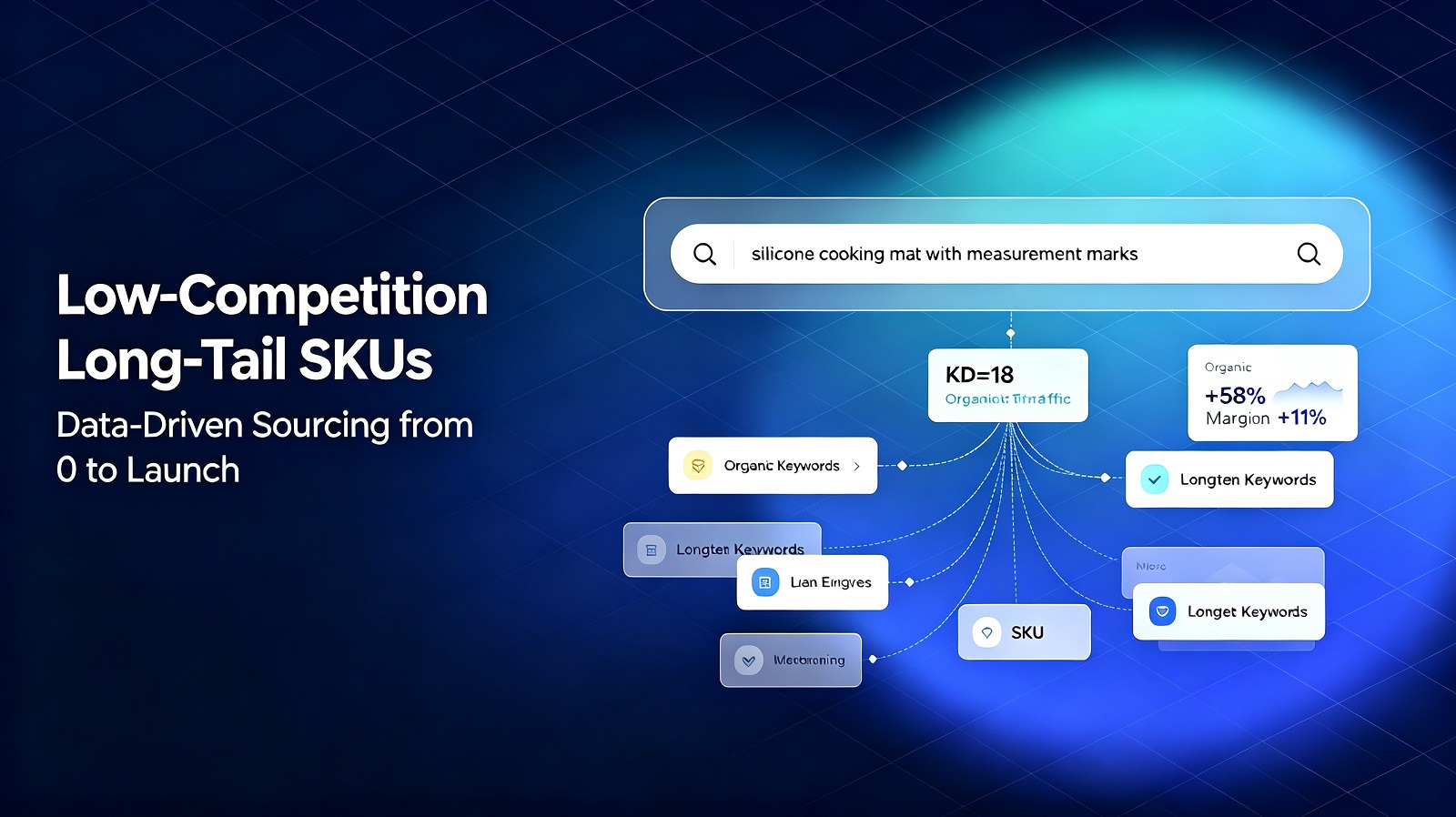
Through store background search records + Reddit community Q&A sorting, we captured the high-frequency pain-point long-tail keyword: “silicone cooking mat with measurement marks for small apartment baking”.
Demand core: Small apartment users need mini-size baking mats with precise scale marks, solving two common pain points of standard large-format mats: wasted counter space and inaccurate baking ratios without printed measurements.
Competition screening result: KD=18, fewer than 12 competing organic listings on Google’s first page, meeting the store’s low-competition screening standard.
Step 2: Targeted SKU Differentiation Optimization
Based on the original ordinary silicone baking mat, we completed lightweight iteration:
Adjust the conventional 6040cm large size to 4030cm mini size for compact living spaces;
Add US standard baking weight and size scale marks on the product surface;
Match portable storage straps to resolve messy kitchen storage issues.
No new mold development was required, only material and accessory adjustments, with trial stocking cost increases of less than 8%.
Step 3: 30-Day Launch & Full Data Performance
After the differentiated SKU went online for 30 days, core metrics shifted as follows:
Natural search traffic: from 0 visits/day to 412 visits/day, all generated from the target long-tail organic search;
Listing conversion rate: stable at 4.8%, 2.1 times the store’s mainstream SKU average of 2.3%;
Single order profit margin: increased from 12% to 27%;
Paid traffic dependence of the product: reduced from 89% to 22%;
Limited price competition: fewer than 12 competing listings targeting this exact long-tail phrase.
Overall Store Effect After Batch Replication
The team replicated this long-tail development logic, launching 47 differentiated niche SKUs in 3 months. Around 70% of these items passed the 30-day trial-sale evaluation criteria, while 30% triggered elimination triggers and were cleared via bundle discounts. Cumulative store-wide improvements included: overall natural traffic increased by 58%, average store profit margin lifted by 11 percentage points, and comprehensive advertising customer acquisition cost decreased by 29%.
Merchant Objective Feedback
Long-tail demand mining helps brands avoid brutal price competition on mainstream search terms. Properly differentiated SKUs built around screened low-competition long-tail phrases deliver precise audience matching and improved profitability. That said, sellers must acknowledge limitations: individual long-tail variants have capped traffic potential, demand can drop off rapidly as trends fade, and consistent quarterly iteration is required to maintain steady niche revenue streams. Small-batch trial limits inventory risk, making this a viable supplementary profit channel alongside core mainstream product lines.
Core Takeaways
Mainstream broad keywords lead to homogeneous competition and sustained high advertising expenditure; properly vetted long-tail niche demands create supplementary low-competition, higher-margin differentiated SKUs, though they cannot fully replace core mainstream inventory.
Four free data channels cover internal store visitor behavior and external public user demands, supporting continuous identification of unmet buyer pain points.
Three distinct long-tail keyword types correspond to standardized lightweight product iteration frameworks, adaptable for small limited-budget teams and established multi-category brands.
Merchants must cross-verify keyword competition via KD scores, SERP homepage competitor audits and ad bid levels to avoid misjudging seemingly low-competition search phrases.
Standardized 30-day trial-sale tracking paired with clear elimination metrics prevents sustained inventory losses from underperforming niche SKUs.
Real store operational data confirms that well-executed long-tail product layouts can lift organic traffic, boost conversion rates and expand profit margins, while carrying inherent risks of low individual search volume and volatile seasonal demand.