
Introduction
A large number of cross-border independent store merchants can capture short-term trending products and obtain temporary order surges. Yet most such SKUs lose sales momentum quickly within 1–2 months. Competitors replicate identical product configurations, pricing and page selling points, triggering price wars and shrinking profit space sharply.
Q2 2026 category survey data shows around 67% of newly launched hot-selling SKUs face obvious sales decline within two months after competitors launch copycat versions. Most sellers only focus on finding new trending goods, ignoring the construction of long-term competitive barriers for existing core products. This article summarizes five sustainable competitive barriers that merchants can build around their winning SKUs, with differentiated execution schemes matching different operation scales, complete standardized operation steps and real store optimization data, to help sellers prolong the profitable cycle of core merchandise.
Industry Background: Short Lifespan of Unprotected Winning Products
Trending products without unique competitive barriers face three inevitable operational risks.
First, fast market replication. Generic functional goods with no exclusive features can be copied by numerous suppliers within a short time, resulting in a surge of identical listings across countless stores.
Second, passive price competition. Without unique selling points, consumers compare products purely by price, forcing sellers to cut profit margins to maintain conversion volume.
Third, shortened product life cycle. Once copycat goods flood the market, the original store’s core SKU will lose traffic advantages and shift to slow-moving inventory rapidly.
A cross-border category research analyst commented: Discovering hot items only solves short-term order demands. Building exclusive competitive barriers for core SKUs can lock stable audience groups and create long-term revenue pillars for independent stores.
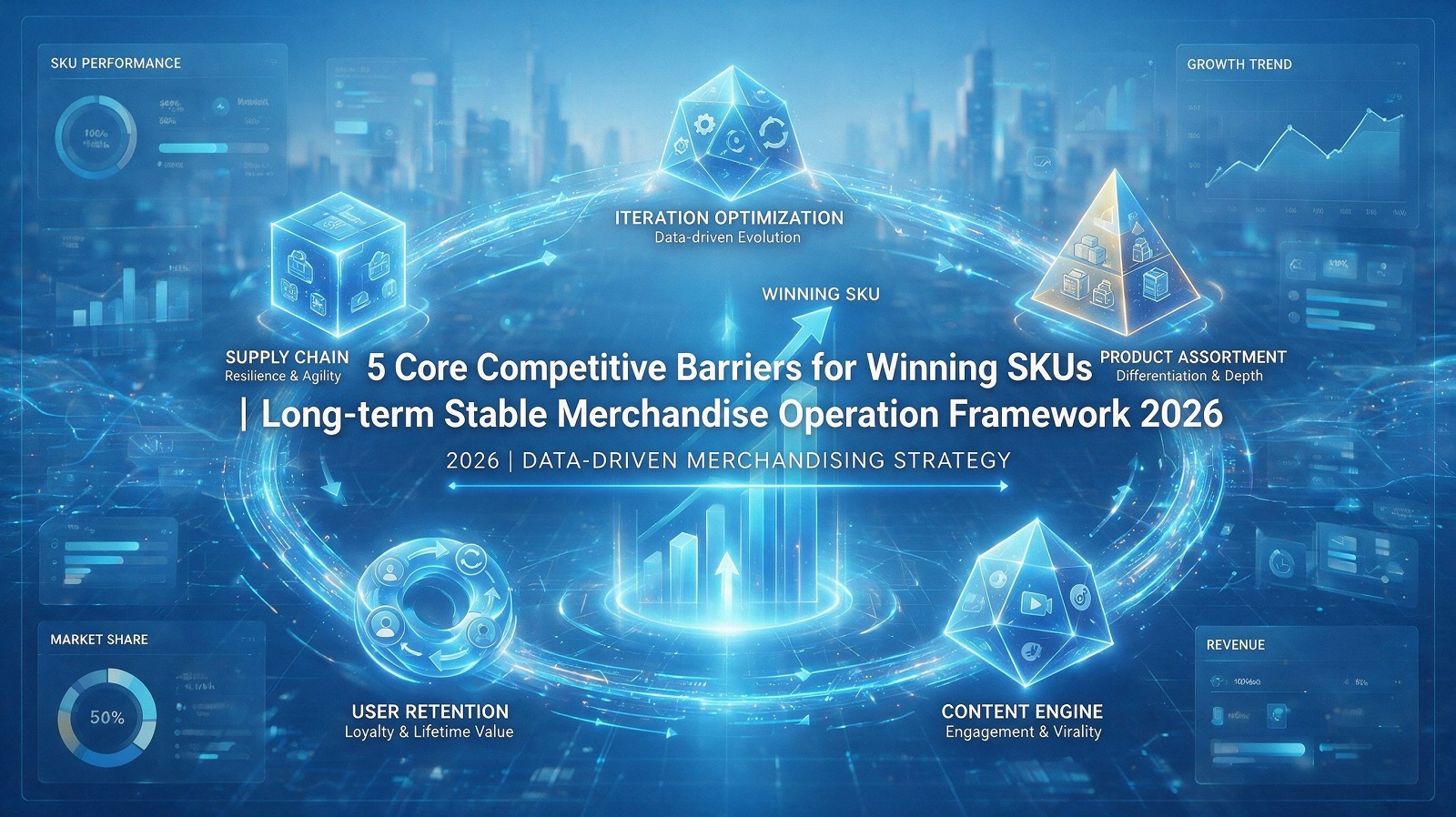
5 Core Buildable Competitive Barriers for Winning SKUs
The five barriers cover supply chain, product matching, store operation, user assets and brand presentation, all executable without excessive upfront investment.
Barrier 1: Exclusive Supply Chain Matching Limit
Negotiate limited batch cooperation with suppliers to obtain exclusive packaging, customized accessories or special material formulas that mass market generic versions do not carry. Restrict the supplier from selling the same customized configuration to other cross-border sellers, forming supply-side differentiation.
Barrier 2: Exclusive Bundle Combination Matrix
Design unique matching accessory sets and multi-spec combination packages exclusive to the store. Competitors can replicate single main products but cannot copy the complete bundle matching logic, raising the store’s average order value and creating unique purchase incentives for visitors.
Barrier 3: Private User Asset Binding Mechanism
Link core winning SKUs with member exclusive discounts, subscriber-only coupons and repeat purchase benefits. Users who buy the core goods will be accumulated into the store’s private user pool, forming stable repeat purchase traffic that competitors cannot capture.
Barrier 4: Scene-exclusive Content Presentation System
Create exclusive usage scenario photos, detailed usage tutorial videos and vertical niche content matching the core SKU. Uniform, specialized scene content forms brand cognitive differences, making visitors associate this product series only with the merchant’s store.
Barrier 5: Continuous Iteration Upgrade Mechanism
Set fixed cycle detail optimization for core SKUs, updating materials, accessory matching and packaging every seasonal cycle. Continuous small upgrades keep the product ahead of static copycat goods launched by competitors, maintaining sustained differentiation advantages.
Differentiated Barrier Construction Strategies for Merchants of Different Scales
Small Boutique Independent Stores (Single Category, Limited Capital)
Small teams prioritize building bundle combination barriers and exclusive scene content barriers. The two modes require low additional cost input and fast implementation. Cooperate with suppliers for simple customized packaging to add mild supply chain differentiation, and bind core SKUs with newsletter subscriber benefits to accumulate private user assets. Complex long-cycle supply chain exclusive cooperation can be delayed until sales scale expands.
Multi-category Brand Merchants (Multi-warehouse Layout, Stable Supply Chain Resources)
Scaled brands can build all five competitive barriers systematically. Sign long-term exclusive customized agreements with suppliers, develop multi-layer bundle combination systems, establish complete member tiered benefit rules, produce professional exclusive scene content, and arrange quarterly iterative upgrades for all core winning SKUs to form comprehensive anti-copycat advantages.
Common Mistakes When Building Product Competitive Barriers
Mistake 1: Only rely on price reduction as competitive means
Long-term price cuts damage profit margins fundamentally and cannot form sustainable barriers. Competitors can easily match lower pricing, leading to continuous vicious competition.
Mistake 2: One-time product optimization without continuous iteration
Single slight modification of products will be quickly replicated by competitors. Without periodic upgrade mechanisms, differentiation advantages disappear within a short sales cycle.
Mistake 3: Ignore private user asset binding for core SKUs
Merchants only pursue one-time transaction conversion and fail to guide buyers into member or subscriber groups, losing the chance to lock repeat purchase traffic exclusive to the store.
Mistake 4: Invest heavily in exclusive supply chain cooperation without stable sales volume
Sign large-scale exclusive customized agreements for newly launched untested SKUs. If the product fails to meet expected sales, merchants face large inventory losses from exclusive customized goods.
Internal guide: You may refer to our previous Winning Products article about micro-innovation differentiated selection, to combine detail upgrades with periodic iteration barriers for stronger long-term product competitiveness.
Standard Full-cycle Barrier Construction Workflow for Winning SKUs
Step 1: Screen core winning SKUs with stable long-term sales potential
Filter SKUs with consistent monthly orders and steady user demand as the carrier for building competitive barriers, avoiding investing resources in short-lived trending flash goods.
Step 2: Select barrier construction modes matching capital and supply chain capacity
Small stores adopt low-cost bundle and content barriers; large brands deploy full five sets of barrier systems with exclusive supply chain cooperation.
Step 3: Complete differentiation optimization and exclusive content production
Finish customized packaging, matching bundle design and exclusive scene material shooting to form visible store-exclusive product differences.
Step 4: Launch private user binding activities linked to core SKUs
Set member exclusive discounts, post-purchase subscription incentives and repeat purchase coupons to convert one-time buyers into private store assets.
Step 5: Set periodic iteration schedules to maintain differentiation advantages
Arrange quarterly small-scale product detail upgrades and content updates to stay ahead of static copycat products from competing merchants.
Daily Winning Product Competitiveness Operation Checklist
Prioritize building low-cost bundle and content barriers for small-volume core SKUs.
Avoid signing high-cost exclusive supply chain agreements before verifying stable long-term sales data.
Bind every core winning SKU with member or subscriber benefit mechanisms to accumulate private user groups.
Arrange fixed quarterly iteration plans for all long-term core merchandise to prevent copycat homogenization.
Develop unique matching accessory combinations to raise average order value and form unique purchase incentives.
Regularly check competing store listings to adjust barrier optimization directions timely when copycat goods appear.
Measurable Long-term Operation Optimization Case
A kitchen gadget independent store owned three core winning SKUs that maintained stable monthly orders in 2025. After several competitors launched identical copycat versions, the store’s overall conversion rate dropped continuously, and profit margins shrank due to price matching pressure.
Starting in Q1 2026, the operation team built multi-layer competitive barriers for the three core SKUs: launched exclusive accessory combo sets, shot niche home scene exclusive content, linked purchases with member discount benefits, and arranged quarterly small product detail upgrades. The store also reached an agreement with suppliers for customized packaging exclusive to its brand.
After four months of continuous implementation:
• The proportion of lost orders caused by copycat competing goods decreased by 46%;
• Store average order value grew steadily via exclusive bundle sales;
• The sales cycle of core winning SKUs was effectively extended;
• The store no longer needed frequent price cuts to maintain conversion volume.
The store merchandising manager shared feedback: Simply finding new hot products cannot solve the trouble of copycat competition. Building multi-dimensional competitive barriers around existing core SKUs lets us retain stable profit space without constantly sourcing new untested merchandise.
Core Takeaways
Most short-cycle trending winning products lack sustainable competitive barriers, easily facing copycat homogenization and price competition risks. Five multi-dimensional barriers can effectively extend the profitable life of core SKUs.
The five barrier types cover supply chain customization, exclusive bundle combinations, private user binding, exclusive scene content and periodic product iteration.
Small boutique stores and multi-category brand merchants can implement differentiated barrier construction plans matching their operational scale and capital capacity.
Combining multi-layer competitive barriers can reduce the impact of copycat goods, stabilize profit margins and form long-term store merchandise advantages.