
Introduction
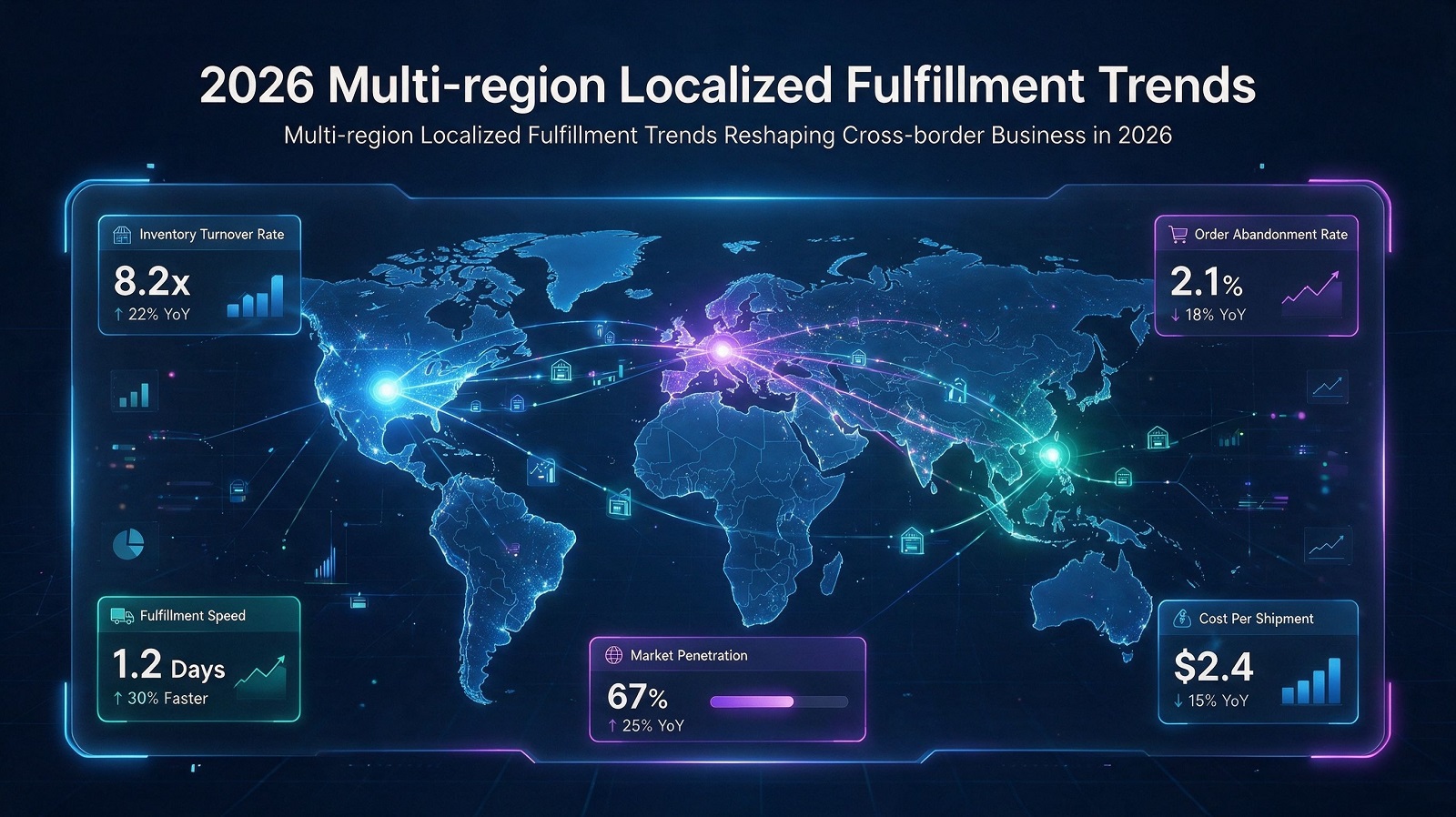
In 2026, cross-border e-commerce operation logic continues to shift from “global unified stocking” to “multi-region localized refined fulfillment”. According to the Q1 2026 cross-border supply chain industry report, more than 58% of growing independent store brands have begun to deploy multi-country warehouse inventory networks, while merchants that still rely solely on single overseas warehouse resources face gradually rising customer acquisition costs and flat conversion rates. Localized fulfillment has evolved from a high-end brand capability to a standard operational configuration for long-term stable store growth. This article analyzes four core industry trends of multi-region localized operations in 2026, differentiates implementation strategies for small and medium sellers and large-scale brands, sorts out quantifiable optimization cases, and provides referable scalable supply chain layout solutions for cross-border merchants.
Four Major Localized Fulfillment Industry Trends in 2026
Different from the traditional model of centralized large-warehouse stocking, the 2026 cross-border supply chain focuses on regional matching, low inventory risk and localized user experience, forming four obvious industry changes.
Trend 1: Regional market segmentation replaces unified global delivery
European, North American and Southeast Asian markets have formed independent user expectation systems in terms of delivery timeliness, after-sales rules and packaging standards. A single unified delivery mode cannot adapt to local consumption habits. More merchants begin to configure independent inventory and localized service standards for core sales regions to reduce user dissatisfaction caused by mismatched delivery experience.
Trend 2: Low-volume multi-region trial stocking becomes mainstream for new SKUs
In the past, merchants tended to stock large quantities in single warehouses, which easily caused slow-moving inventory losses once market demand changed. In 2026, low-batch regional trial stocking has become a common risk-control method. Brands verify market acceptance through small-volume laying of goods in multiple regions, and then carry out targeted replenishment, which effectively reduces overall inventory pressure.
Trend 3: Local after-sales capability becomes a key conversion influencing factor
Search engine and social platform algorithm updates gradually increase the weight of local service indicators. Stores with localized return addresses and regional after-sales processing channels have relatively lower page bounce rates and higher checkout trust. Localized fulfillment capability no longer only affects logistics timeliness, but also interferes with overall store conversion performance.
Trend 4: Supply chain data regionalized refined management
Leading brands have begun to split global inventory data into regional independent statistical dimensions, including regional sales velocity, local inventory aging, regional return rate and market seasonal demand differences. Refined regional data analysis supports more accurate stocking decisions.
Differentiated Layout Strategies for Sellers of Different Scales
Localized fulfillment does not mean blind global warehouse layout. Merchants need to formulate matching strategies according to team scale and business stage.
SME Independent Store Sellers
Small and medium teams are suitable for adopting the “core regional fixed warehouse + auxiliary flexible transshipment” model. It is not necessary to lay out inventory in multiple countries at the same time. Merchants can focus on 1–2 core profit markets, stabilize localized delivery experience, and use cross-warehouse transfer capabilities to assist scattered order demands. This mode balances operational stability and capital security.
Medium & Large Cross-border Brands
Scaled brands can build a multi-node warehouse network, realize regional inventory partitioning, and configure independent after-sales processing rules for different markets. By matching regional seasonal demand and user preference data, brands can complete dynamic inventory allocation to improve overall inventory turnover efficiency.
Four Core Advantages of Standardized Localized Fulfillment Layout
Compared with traditional cross-border long-distance delivery and single-warehouse centralized stocking, multi-region localized operation brings multi-dimensional steady improvement to store operation.
Advantage 1: Optimize user shopping experience and reduce order abandonment
Local warehouse delivery shortens overall logistics cycle, meets local user’s habitual delivery expectation, and reduces cart abandonment caused by long shipping cycles.
Advantage 2: Reduce customs clearance and regional policy risks
Regional localized warehousing can adapt to local import filing and commodity supervision rules, reduce detention risks caused by cross-border long-distance customs clearance, and improve the stability of commodity sales in target markets.
Advantage 3: Realize low-risk new product testing
Multi-region small-batch trial stocking avoids large-scale inventory backlog risks, helps merchants quickly verify new product market feedback, and provides data basis for subsequent large-scale promotion.
Advantage 4: Improve overall store organic trust weight
Complete localized logistics tracking, local return channels and regional after-sales support help improve website credibility, which is conducive to long-term organic traffic accumulation.
Standard Multi-region Localized Fulfillment Implementation Process
The whole set of processes is suitable for new market expansion and existing supply chain iteration, with strong operability for merchants of all scales.
Step 1: Sort out core target market classification
Divide markets into core profit areas, potential growth areas and trial areas, and allocate different inventory strategies and service standards respectively.
Step 2: Formulate regional SKU stocking rules
Match high-demand conventional SKUs for core regions, arrange trial new products for potential regions, and avoid blind full-SKU coverage.
Step 3: Access multi-warehouse unified management background
Realize centralized viewing of global inventory data, independent statistical analysis of regional data, and automatic reminder of slow-moving inventory.
Step 4: Configure localized delivery and after-sales rules
Set market-adaptable packaging standards, local return addresses and regional after-sales processing cycles to unify user experience.
Step 5: Regularly iterate regional inventory allocation strategies
Adjust regional stocking proportion according to monthly seasonal changes, market policy updates and regional sales data to maintain dynamic balance of inventory.
Daily Localized Supply Chain Operation Checklist
1. Classify market levels to avoid excessive inventory dispersion and rising logistics costs.
2. Establish regional inventory aging monitoring mechanism to reduce long-term stagnant inventory.
3. Match localized after-sales processing channels for core sales areas to improve user satisfaction.
4. Take regional sales velocity as the core basis for replenishment judgment to improve turnover efficiency.
5. Synchronously update packaging and labeling standards according to local market regulatory requirements.
6. Use multi-warehouse data unified management to avoid data deviation caused by scattered inventory.
Quantifiable Industry Optimization Case
A European-focused home goods independent station team used to adopt a single German overseas warehouse stocking model in 2025. Affected by regional seasonal demand differences and single inventory pressure, the store’s annual inventory turnover rate was 4.2, and the monthly average order abandonment rate remained at 8.7%.
In Q1 2026, the merchant launched a dual-warehouse localized layout, adding a French regional warehouse for Western European multi-country order coverage, and implemented differentiated stocking and localized delivery strategies for different regions.
After three months of stable operation, the store achieved obvious data optimization:
• Overall inventory turnover rate increased from 4.2 to 5.8;
• Monthly cart abandonment rate dropped from 8.7% to 5.1%;
• Regional order abnormal processing rate decreased by 39%;
• No large-area slow-moving inventory occurred during seasonal switching.
The brand operation manager stated: “Localized fulfillment is not simply increasing warehouse quantity, but realizing precise matching between inventory and market demand. Reasonable regional layout can effectively smooth the seasonal fluctuation of store orders.”
Key Takeaways
1. The 2026 cross-border supply chain is accelerating toward multi-region localization, refined data management and low-risk trial stocking.
2. Small teams and large brands have completely different localized layout logics, and blind replication of large-scale warehouse deployment will increase operational risks.
3. Localized fulfillment not only optimizes logistics experience, but also positively affects store conversion, organic weight and after-sales stability.
4. Dynamic regional inventory allocation and standardized local service configuration are important guarantees for long-term stable operation of independent stations.