
Introduction
With the continuous expansion of business scale, many medium and large cross-border DTC brands have built exclusive self-developed ERP management systems to unify multi-platform store orders, inventory planning, financial reconciliation and team permission management. However, most overseas warehouse fulfillment platforms lack standardized open data interfaces, forcing operation staff to repeatedly export and import order and inventory data between two systems every day. Manual data collation not only consumes a great deal of labor costs, but also easily causes information errors, order omission and inventory counting deviation, which brings hidden risks to brand daily operation. After three months of internal development, repeated testing and merchant beta verification, Globe Fulfillment officially launches the full-version open ERP API interface, opening standardized data access channels for all cooperative sellers to realize one-stop closed-loop management of front-end sales and back-end fulfillment. This article introduces the core interface capabilities, access process, exclusive service policies and practical application effects of the newly launched open API, helping brand customers realize truly automatic and unmanned data linkage.
Core Background & Original Pain Points That Drive API Function Development
For small and micro sellers with single independent stations, logging into the official background to manually create orders and check inventory can meet basic operation demands. But for group brands with multiple stores, multi-country warehouse layout and self-built management systems, isolated data between ERP and fulfillment background will form obvious operational obstacles.
First, frequent manual data transmission leads to low work efficiency. Operation teams need to download order forms from the brand ERP every day, upload them to the overseas warehouse background one by one, and then manually copy logistics tracking numbers back to the store system. A large merchant with daily orders over 3000 needs to arrange 2~3 dedicated employees to be responsible for data docking all day long.
Second, asynchronous data information is easy to trigger business errors. Inventory quantity cannot be updated in real time. The brand system may display available stock while the overseas warehouse has actually run out of goods, resulting in oversold orders and subsequent customer refunds and bad reviews. In addition, the inconsistency of billing data will increase the difficulty of financial monthly reconciliation.
Third, customized system development has extremely high threshold and cost. Before the official opening of the general API, brands that want to realize data interconnection can only carry out targeted private development docking, which requires long development cycles and high technical cooperation expenses, and cannot be popularized to most growing sellers.
The person in charge of Globe Fulfillment Technical R&D Center said in the official release: “Our product iteration has always centered on reducing the operational burden of merchants. The launch of open API is to break the data island between brand internal management system and global fulfillment network, and make supply chain management more lightweight and intelligent.”
Main Functional Modules of The New Open ERP API System
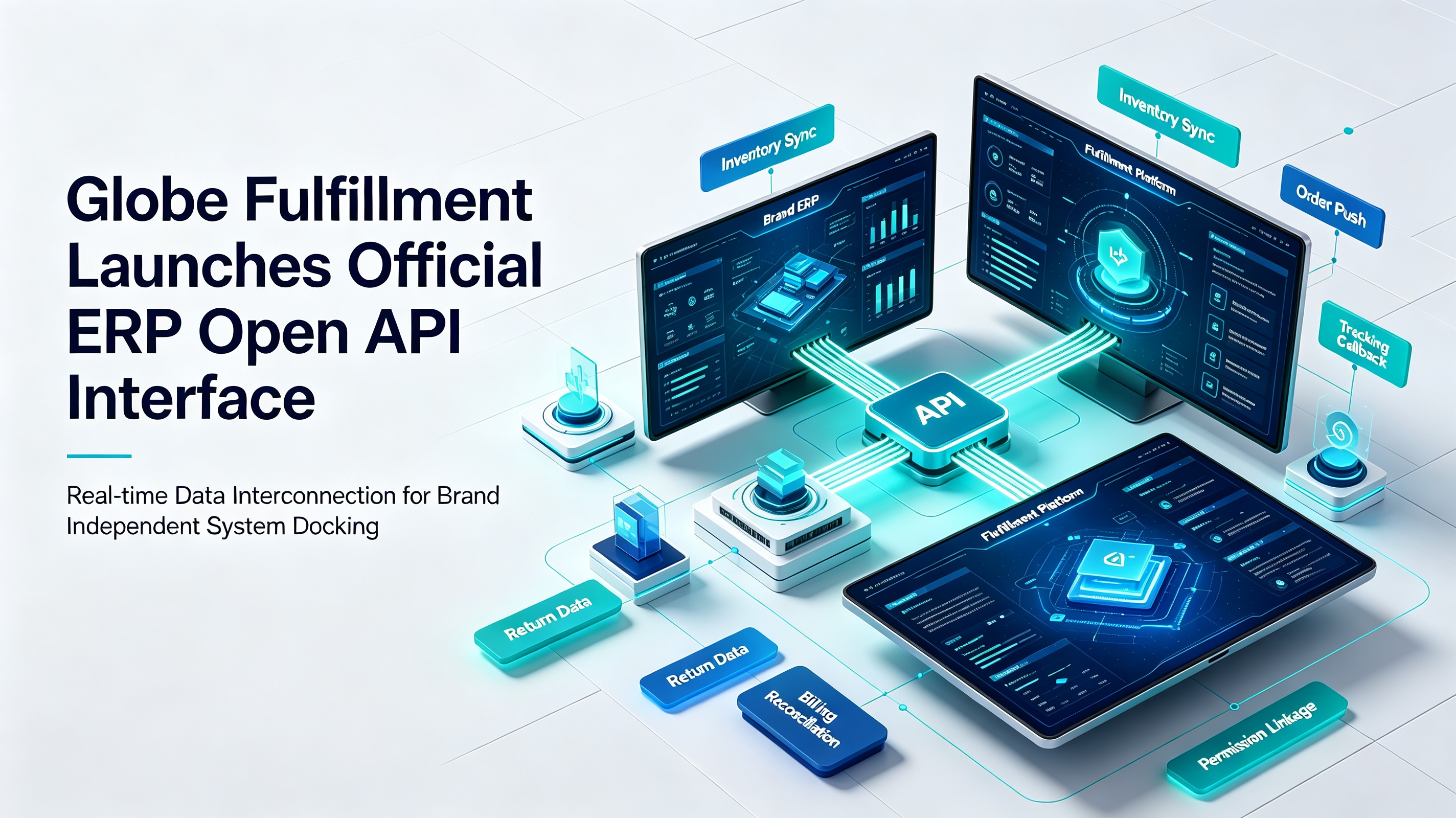
The officially released open interface covers six core data modules to realize bidirectional automatic data transmission between the two systems.
The first module is real-time inventory synchronization API. It automatically push the latest stock quantity, in-transit goods quantity and pending inspection inventory data of all bound overseas warehouses to the merchant ERP every 5 minutes, so the brand management terminal can always grasp accurate inventory status and effectively avoid oversold risks.
The second module is order automatic pulling & pushing interface. Merchants can set up rules in their own ERP to automatically push generated orders to Globe Fulfillment background for direct outbound, without any manual import operation. Meanwhile, the system will feed back order outbound results in real time.
The third module is logistics track callback API. After the overseas warehouse generates the express bill number and starts delivery, the tracking information will be automatically pushed back to the brand ERP and bound to the corresponding order, which can be directly synchronized to independent stations and social e-commerce platforms.
The fourth module is return goods data notification interface. All returned parcel information, inspection results and re-warehousing status will be synchronously transmitted to the merchant system, facilitating unified after-sales data statistics and problem SKU analysis.
The fifth module is bill & settlement data interface. Monthly expense details, COD settlement records and deduction items can be pulled in batches through the interface, directly docking with the financial accounting module of the brand ERP to greatly shorten the financial closing cycle.
The sixth module is sub-account and permission linkage interface. The main account can synchronize sub-account information and operation authority settings to the fulfillment background in batches, realizing unified team personnel management on the brand side.
Standard Step-by-Step API Access & System Docking Process
Step 1: Submit API opening application and obtain developer credentials Cooperative merchants submit an interface opening application through exclusive customer manager or merchant background application entrance. After qualification review, the system will issue unique API access key and secret key to complete identity authentication.
Step 2: Read official technical documentation and complete docking development The technical team of the brand downloads the standardized interface document provided by Globe Fulfillment, carries out targeted joint debugging and development according to the required data modules, and supports test environment data simulation to avoid affecting formal order business.
Step 3: Complete joint debugging in the test environment Carry out simulated order push, inventory query and data callback in the test environment to verify the stability and accuracy of data transmission, and eliminate abnormal situations such as data loss and repeated push.
Step 4: Switch to official environment and enable formal data synchronization After the joint debugging is fully passed, apply to switch the interface from test environment to official environment, start real order and inventory data interconnection, and the manual order entry work can be stopped.
Step 5: Open after-sales technical support and long-term version iteration The technical support team provides 7×12 hours online assistance for problems during use. The interface will continue to iterate new functions according to merchant feedback and industry business demands.
Exclusive Benefit Checklist For Merchants Who Open API Docking Within The First Month
- All merchants that complete formal API access within 30 days of launch will be exempted from annual interface service fees permanently.
- Provide free one-on-one technical docking guidance and document interpretation by professional engineers for enterprise customers with self-developed ERP.
- For brand groups with more than 5 sub-accounts, waive the additional multi-account data synchronization management fee.
- Priority access to newly launched functional interfaces in subsequent system iterations, enjoying advance testing and opening qualifications.
- Merchants with large daily order volume can apply for customized interface frequency adjustment to adapt to high-concurrency order transmission demands.
- Free regular data security inspection for API docking accounts to prevent illegal access and data leakage risks.
Real Brand Docking Case & Operation Feedback
A cross-border home furnishing group brand has independently built a set of full-channel ERP system to manage 8 independent station stores and multi-platform online shops. Before accessing the open API, the operation department arranged two full-time staff to import orders and copy logistics numbers every day, which was not only labor-intensive but also often had order missing and inventory oversold problems.
After applying for Globe Fulfillment open ERP API and completing system docking within one week, all order pushing, inventory query and logistics callback are fully automated without manual intervention.
Within one month after going online, the brand cut two dedicated data entry posts, the order error rate dropped to nearly zero, the monthly financial reconciliation time was shortened from 7 working days to less than one day, and the overall supply chain operation efficiency was significantly improved.
The brand IT director commented: “The open API eliminates the biggest data barrier between our internal system and overseas warehouse fulfillment. The whole business link becomes closed-loop and traceable, and the management of multi-store and multi-warehouse business becomes much simpler and controllable.”
Key Takeaways
- Globe Fulfillment officially launches general open ERP API interface, realizing bidirectional data interconnection between merchant self-built system and global fulfillment background.
- The interface covers inventory, order, logistics, return, billing and permission management modules, basically meeting the data docking demands of most medium and large cross-border brands.
- Standardized document + test environment + technical after-sales support greatly reduces the development difficulty and time cost of brand system docking.
- Automated data synchronization can effectively reduce manual errors and labor costs, improve inventory accuracy and financial reconciliation efficiency, and reduce invisible operational risks for enterprises.